
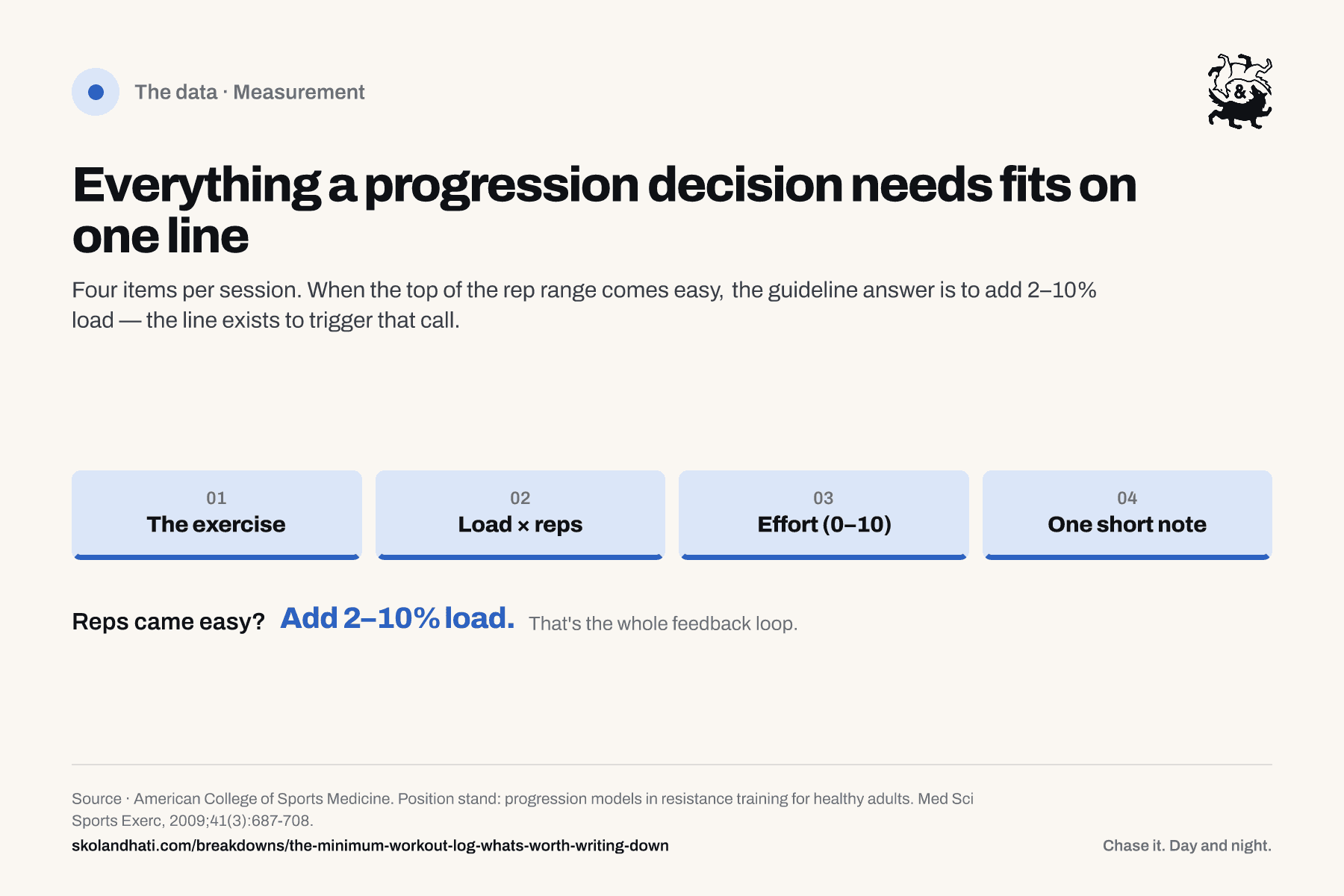
A workout log needs four items per session: the exercises, the load times reps, one effort number, one short note. That is everything the next session's decision needs. The standard progression rule — add 2–10% load once the reps come easy — only works if you know last time's numbers [2]. Whether tracking changes results at all is its own article.
01What belongs in a workout log?
Four items: the exercise, load × reps, one effort number, one short note. That is every input a progression decision needs, and it fits on one line.
Getting stronger has an accounting rule behind it. The American College of Sports Medicine's progression guideline says to raise the load 2–10% once you can do one or two reps beyond your target [2]. Read that as a logging requirement. You cannot apply the rule without two facts: what you lifted last time, and how many reps you got. A log is a bookmark, not a diary. It does not do the training for you. It just means you never restart the book from page one.
The road you pick matters less than knowing where you stand on it. An 8-week trial randomized 43 trained lifters to progress by adding load, or by adding reps at a fixed load [1]. Squat strength rose about the same either way — 21.8 kg in the load group, 19.3 kg in the reps group — and muscle growth came out similar at most sites [1]. Both roads run through the same line in the log: last session's load and reps. The line is the working part. The rest of your numbers can wait on the shelf.
02What is a session RPE, and why only one effort number?
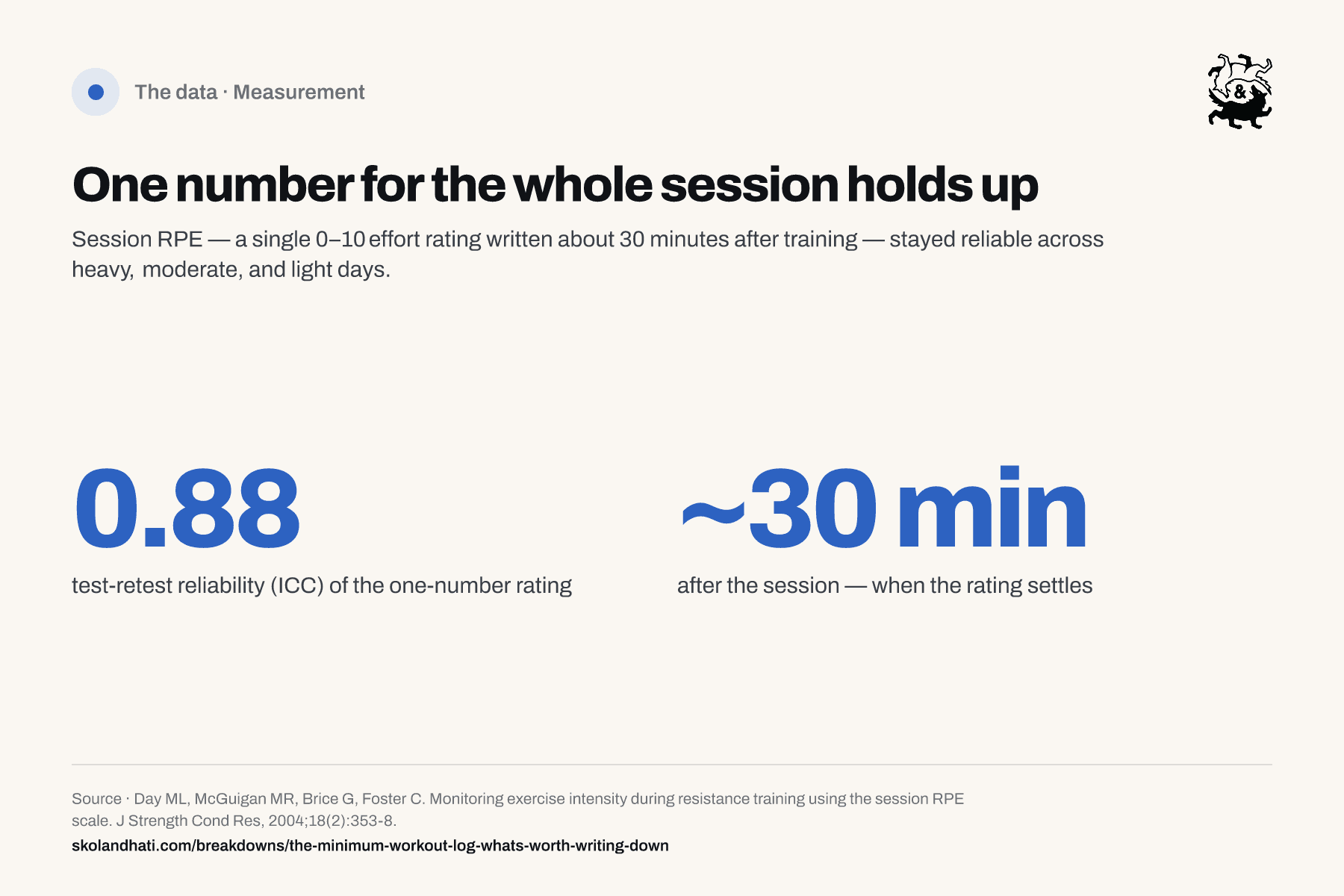
One 0–10 rating for the whole session, written about 30 minutes after. It held steady across heavy, moderate, and light days — ICC 0.88 [4].
Session RPE is rating the whole movie once the credits roll, instead of pausing to score every scene. After the session, you ask one question — how hard was that, 0 to 10, on the modified CR-10 scale — and write the answer down [5]. The method's original test put it against an objective standard built from heart-rate data, across steady cycling, interval cycling, and basketball practice. The two scores moved together throughout, in different people and different kinds of work [3].
It carries over to the weight room. A study had 19 adults — nine men, ten women — repeat heavy, moderate, and light sessions, rating each one 30 minutes after finishing [4]. The single number set the heavy days apart from the moderate and light ones, and it repeated well: an intraclass correlation of 0.88 [4]. A later review counted 36 studies checking the method and called its reliability good across sports, ages, and levels [5]. One honest number, written after the shower, is a validated record of how hard the day was.
By signing up you agree to receive our emails, including occasional offers, and to the privacy policy.
03What's noise — and can logging too much backfire?
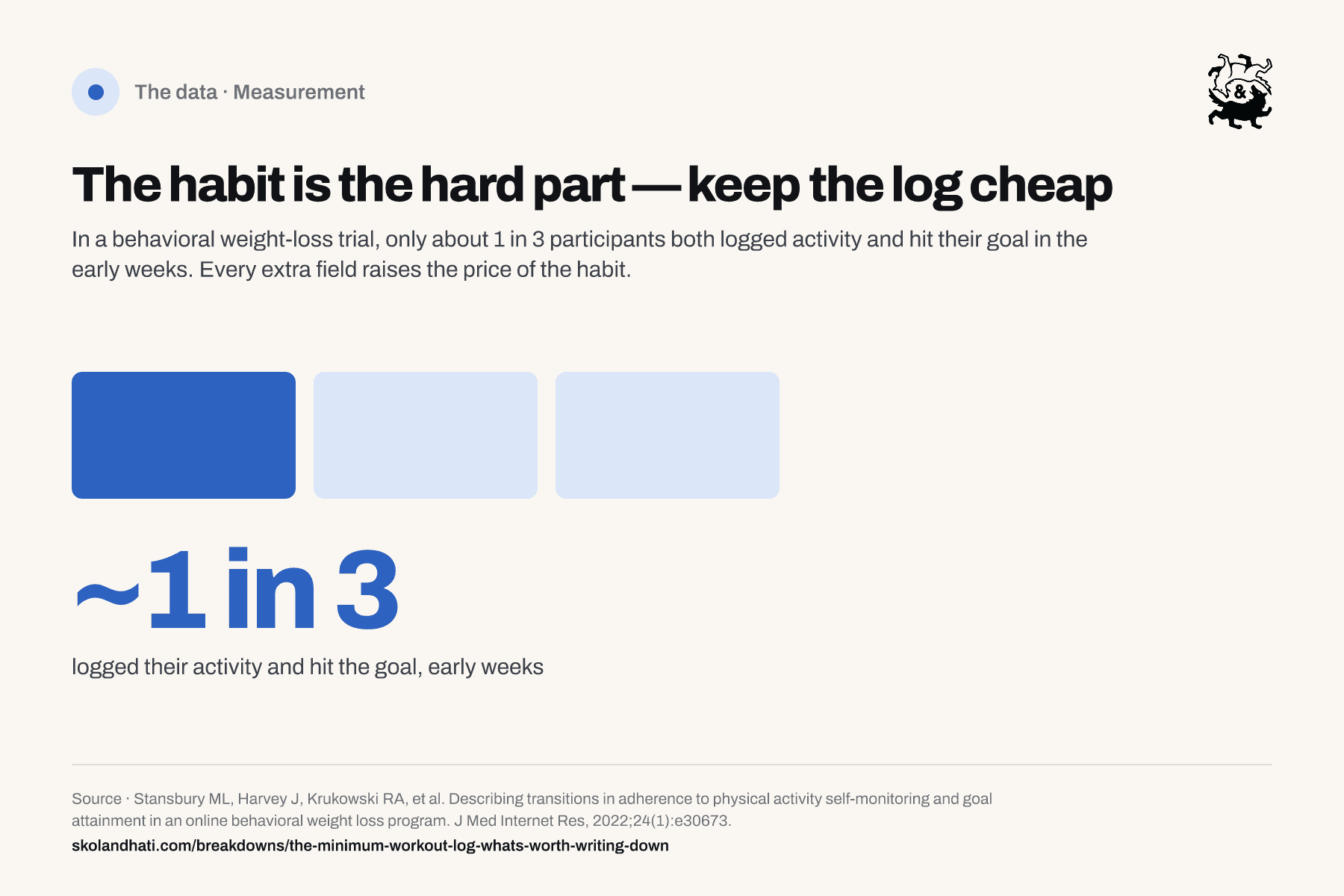
Direct evidence that over-logging makes people quit is thin. The nearest data shows logging habits decay within weeks, so every extra field raises the price of the habit [6].
Noise, for most people: per-set rest times, tempo counts, bar speed, per-set effort ratings, mood sliders, and the watch's calorie guess. None of it feeds a decision the four items don't already feed. A 20-minute dumbbell session produces a one-line entry, and the week's bigger picture lives in your set budget, not in a spreadsheet of tempos.
Here is the honest part: nobody has run a trial pitting a four-item log against a forty-field one, so the over-logging case rests on adjacent evidence. The nearest data comes from a 6-month online program that asked 212 adults to self-report activity daily. In the early weeks, roughly one in three managed both the logging and the step goal, and the week-to-week drift ran toward logging less, not more [6]. Logging is a habit with a price, and the price gets paid every session. Missed weeks are the base case for people with full lives — the log's job is to make restarting cheap. Open the page, read one line, know where you left off.
Do you need an app to keep a workout log?
What is a good session RPE number?
When should you write the effort number down?
Should you log rest times, tempo, or bar speed?
Is one note per session really enough?
General-audience information — not medical advice. General education about record-keeping, not programming or medical advice. Skol & Hati builds a training app. Read anything here about apps with that in mind. How we source and verify. No affiliate links in this breakdown. Published 2026-09-21.
Does tracking workouts actually change results?
Writing it down is one of the best-tested tricks in behavior science. The effect is real, modest, and dies the moment the log stops feeding a decision.
4 min · September 14, 2026MeasurementHow accurate is your watch? Steps, heart rate, and sleep
The validation studies rank your watch's numbers: steps good, pulse decent, calories bad, sleep stages a rough sketch. Here is the honest league table.
5 min · September 17, 2026