
Lab checks say your watch counts steps well and reads a steady pulse within a few percent [1]. Exercise readings slip on some movements. Calorie burn missed by more than 30 percent for every brand reviewed [4]. Sleep staging is the weakest read [5]. Use each number for its trend, not its absolute value.

01Can I trust the step count?
Steps are the strongest number on your wrist: in lab tests, 45 percent of checks landed within 3 percent of a hand count, with a small undercount typically [1].
The biggest review of wearable accuracy pooled 158 studies across nine device brands [1]. In lab settings, where researchers count steps by hand, 45 percent of step comparisons landed within 3 percent of the true count. The typical miss was a small undercount — a median of 2 percent low. Out in normal life the picture loosened: 42 percent of comparisons stayed within 10 percent, with a slight overcount on average.
That is a good report card by measurement standards. A number that lands within a few percent, and errs the same direction most days, is a usable ruler. If your count says 6,400 today and 8,100 next Tuesday, the difference is real even if neither number is exact. That is the standard to hold all of your numbers to: consistent enough to compare against yourself.
02How accurate is the heart rate during exercise?
Wrist pulse readings sit within about 3 percent at rest and on steady cardio; error runs roughly 30 percent higher once you move, and some activities read worse than others [1][3].
Your watch reads pulse with light. It shines a green LED into your wrist and watches the tiny flicker as blood pushes through with each beat — like watching a candle flame through a frosted window. Sit still and the flame is easy to follow. Swing your arm and the window shakes. In lab comparisons against ECG and chest straps, 57 percent of wrist readings landed within 3 percent, with a median error of just 1 percent low [1].
Movement is where it bends. A Stanford lab study put seven devices on 60 adults and found six of the seven held a median pulse error under 5 percent while cycling — the stillest wrist — while walking produced the worst readings [2]. A separate study found absolute error during activity ran about 30 percent higher than at rest, and devices differed most in how fast they caught a change of pace [3]. So: steady cardio, believable. Intervals and anything wrist-heavy, add salt. The reading it does best is the one you take doing nothing — your resting heart rate.
By signing up you agree to receive our emails, including occasional offers, and to the privacy policy.
03Why is the calorie number so far off?
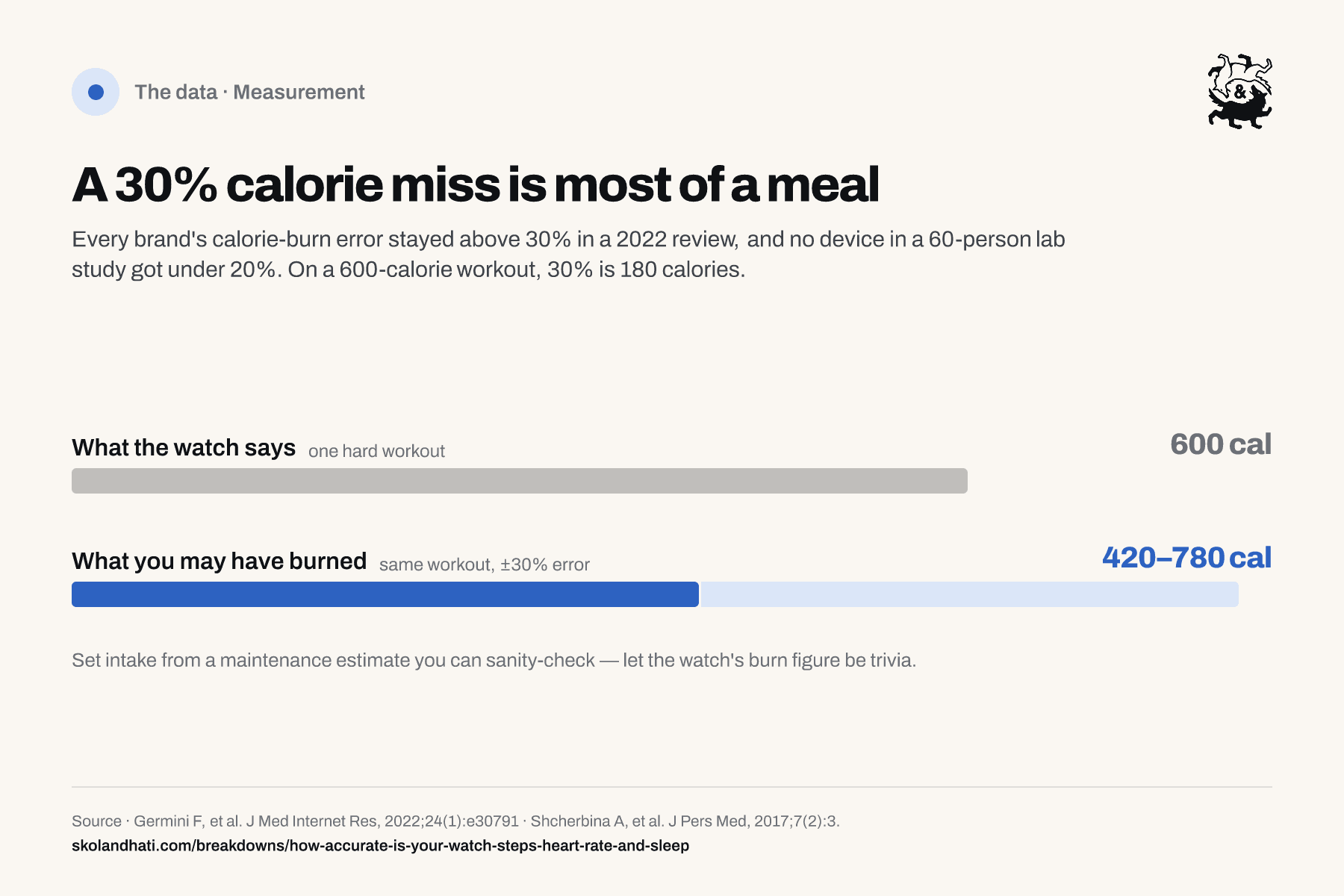
Calorie burn is the weakest daytime number: error stayed above 30 percent for every brand in a 2022 review, and no device in a 60-person lab study got under 20 percent [2][4].
Steps are counted and pulse is read, but calories are inferred. The watch takes motion and pulse and runs them through a formula fitted to other people's bodies — a guess stacked on a guess, like pricing a grocery cart by the weight of the bags. The big review found only 9 percent of energy-expenditure checks landed within 3 percent of lab measurement, and no brand cleared that bar more than 13 percent of the time [1].
This is not one bad brand. The Stanford study found no device under 20 percent error [2], and a 2022 systematic review put the mean error above 30 percent for every brand tested [4]. A 30 percent miss on a 600-calorie workout is 180 calories — most of a meal. If you make food decisions from that number daily, the error compounds weekly. Better to set intake from a maintenance estimate you can sanity-check and let the watch's burn figure be trivia.
04Does my watch really know my sleep stages?
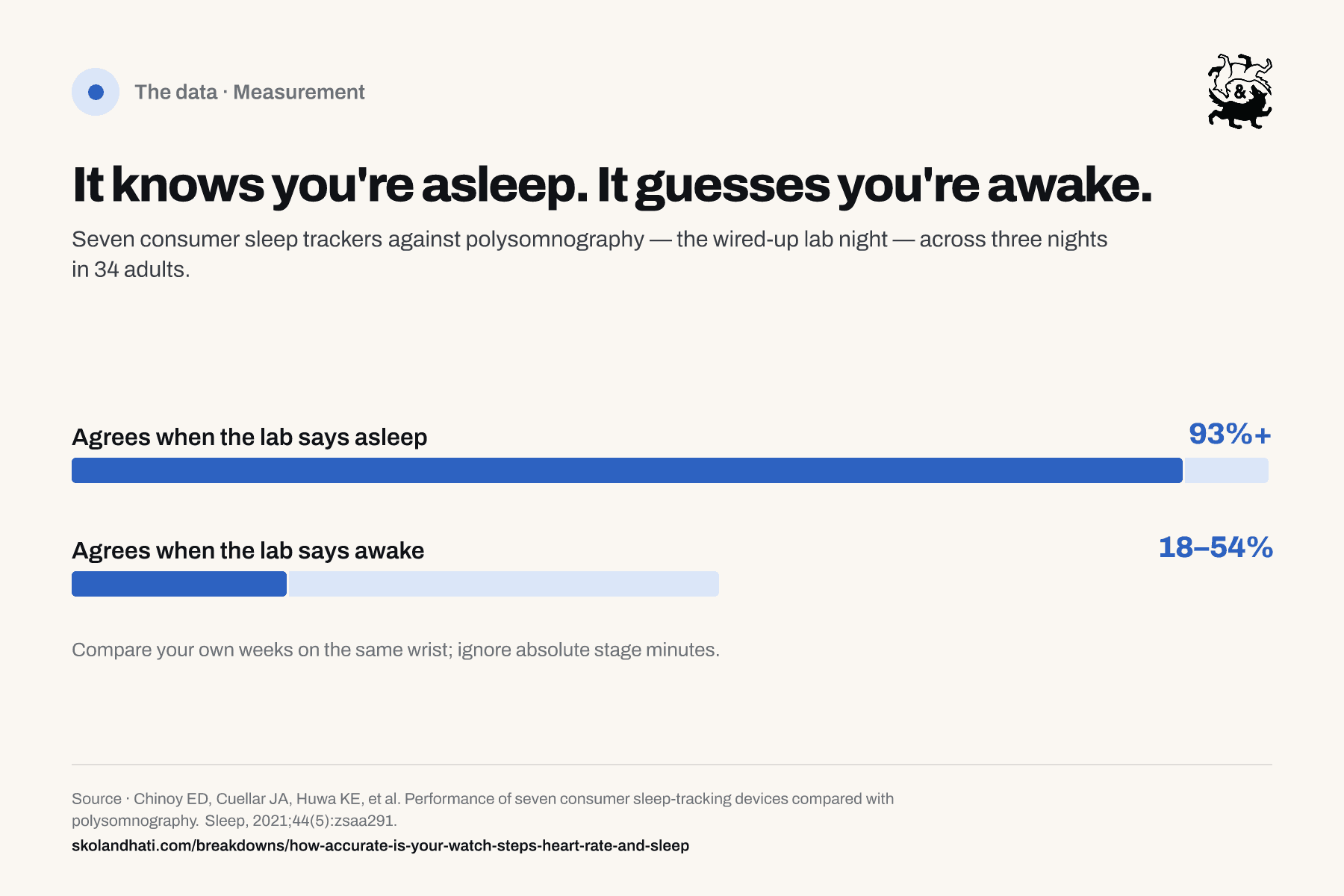
Devices agree with the sleep lab 93 percent-plus of the time you're asleep, call wake right only 18 to 54 percent of the time, and stage minutes are a sketch [5].
The reference here is polysomnography — the wired-up lab night that reads brain waves directly. A head-to-head study tested seven consumer devices — four worn, three bedside — across three lab nights in 34 adults [5]. When the lab said asleep, the devices agreed at least 93 percent of the time. When the lab said awake, they agreed only 18 to 54 percent of the time. Stage calls — light, deep, REM — were mixed, and devices tended to get worse on broken nights, exactly when you care most.
A wrist device is guessing stages from movement and pulse, like judging what's cooking from outside the kitchen door. You'll know a roast from an empty oven; you won't get the seasoning. A 2025 meta-analysis of 24 studies and 798 people found nightly sleep totals differed from the lab by about 17 minutes on average, wake-after-sleep-onset by about 13 minutes, and sleep efficiency by about 5 points [6].
Off by 17 minutes on duration is honestly useful. Off on stages is not a scandal — it just means the deep-sleep minutes are an estimate, not a measurement. Same rule as HRV: compare this week's numbers with your own last month, on the same wrist, and ignore the absolute stage minutes. A run of short nights on the graph is signal. One night's REM total is noise.
Should I eat back the calories my watch says I burned?
Is a chest strap more accurate than a wrist watch?
Do wrist readings work on darker skin?
Can I trust my deep sleep and REM minutes?
General-audience information — not medical advice. Skol & Hati builds a training app. Read anything here about apps with that in mind. Device brands appear on this page only as subjects of the cited validation studies — this is not a buying guide or a ranking. Wearable readings are general information, not clinical measurements; anything that worries you belongs with your doctor, whose read counts. How we source and verify. No affiliate links in this breakdown. Published 2026-09-17.
Resting heart rate: the free recovery metric you already wear
What normal looks like, what moves it overnight, and why a week of mornings beats any single reading.
5 min · September 5, 2026RecoveryHRV: what your watch is actually measuring
The gaps between your heartbeats, the math your watch runs on them, and why the number only means something compared with your own baseline.
5 min · September 5, 2026