

How to build a workout routine around the time you actually have
Most plans start with the training and hope the calendar cooperates. This one starts with the minutes you can defend, then buys the best training they afford.
01How many minutes a week can you actually train?
Count the minutes that survive your real weeks, then program those. Lack of time is among the more commonly reported barriers to sticking with an exercise program [2].
Most workout plans start with the training and hope the calendar cooperates. Six days, ninety minutes, a meal schedule. Then a project lands, a flight slips, and week three never happens. Everything in our training library works better in the reverse order: fix the minutes first, then buy the best training those minutes can afford. The research on why people quit backs this up — lack of time sits among the more commonly reported barriers to sticking with an exercise program [2].
So begin with an audit, not an ambition. Look at your last three ordinary weeks, not your best one. Count the slots that actually survived: the 25 minutes before the house wakes up, two lunch breaks, one weekend hour. That total is your training budget. A plan built on it can run for a decade. Twenty-minute sessions exist precisely because that is the slot many full lives can defend.
For most people with full calendars, the audit lands somewhere between 60 and 180 minutes a week. That can feel like an admission of defeat, because fitness culture prices everything in hours. The evidence below prices it differently. Every worthwhile adaptation has a documented floor, and most of those floors are lower than the culture suggests [1][2][7]. The rest of this article walks the decision tree in order: minimums per goal, then how to split the days, then how to bend the plan around your body and your worst weeks.
Why the honest number beats the ambitious one
Consistency is not a virtue here; it is the mechanism. In a study that followed 111 new gym members for 12 weeks, it took about six weeks of steady repetition for exercise to become a habit, and consistency itself was the strongest thing driving that change [12]. Repetition in stable slots is what turns training from a nightly decision into a default.
That study's habit threshold was four sessions a week, which is a lot [12]. The lesson is not the four. It is that the same slot, kept, does the psychological heavy lifting. A modest schedule you repeat beats an impressive one you renegotiate every Sunday night.
02What is the minimum effective dose for each goal?
Strength: one hard set, 2–3 times a week [1]. Muscle: about four weekly sets per muscle [2]. Health: 150–300 minutes of moderate cardio a week [6].
A minimum effective dose is the espresso shot of programming: a small cup, same active ingredient. It will not maximize anything. It answers a narrower question — what is the least that still produces measurable change? For a fixed calendar, that floor is where planning starts.
Strength: one hard set, two or three times a week
A 2020 review and meta-analysis asked exactly this for the big barbell lifts in trained men [1]. The floor it found: a single set of 6–12 reps at roughly 70–85% of max, taken close to failure, done 2–3 times a week for 8–12 weeks. That dose added about 12 kg to one-rep maxes on average — gains the authors call suboptimal, yet significant [1]. Ten focused minutes covers most of a strength adaptation's price of admission.
Muscle: about four weekly sets per muscle
For muscle size, weekly sets are the currency. A review of time-efficient training recommends a minimum of four weekly sets per muscle group, lifted in a 6–15 rep range [2]. More buys more: in the dose-response analysis, each added weekly set was associated with roughly 0.37% extra muscle growth, and higher-volume programs beat lower-volume ones by about 3.9% [3]. Where the returns flatten is the subject of the weekly set budget.
Cardio and health: the 150-minute line
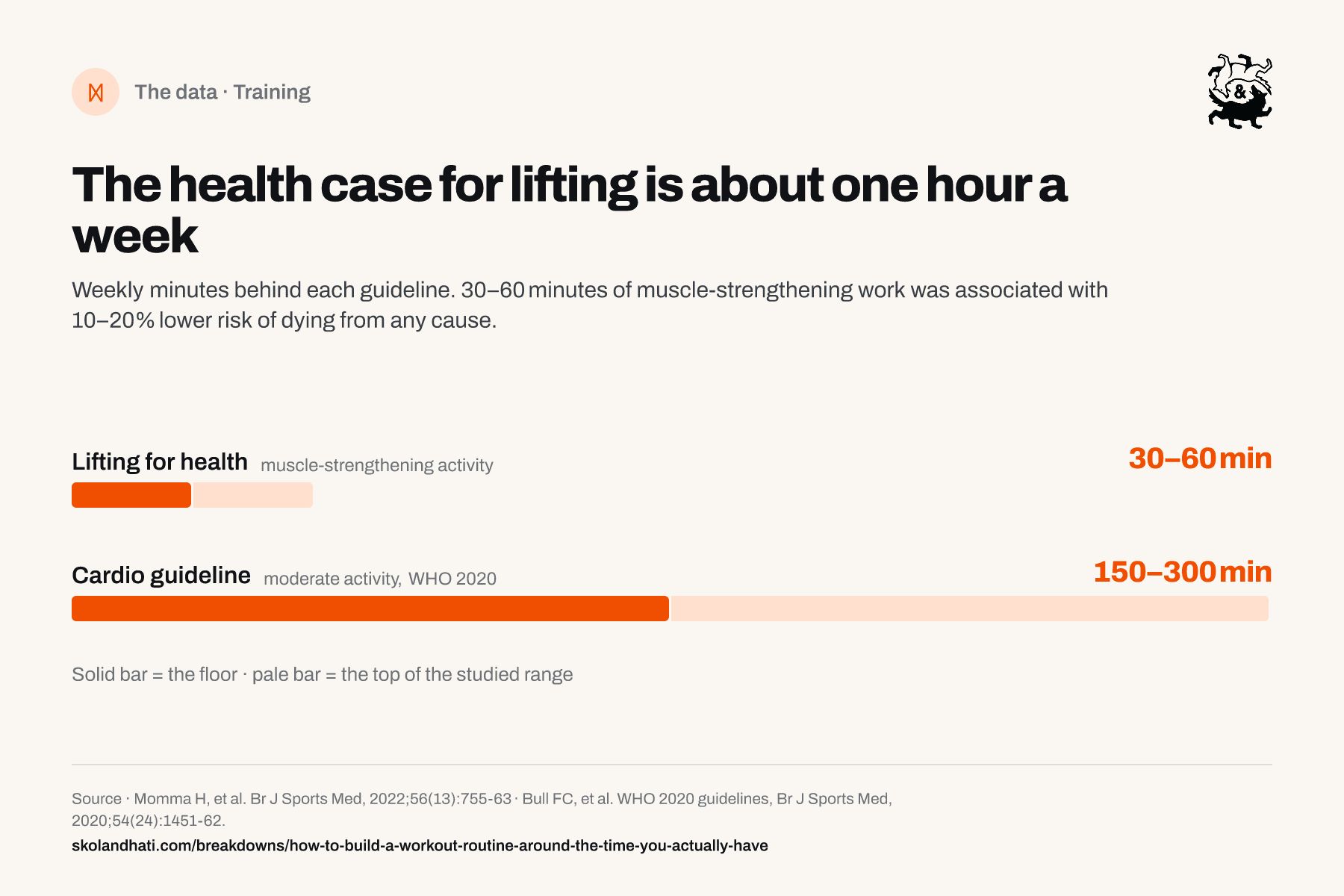
The WHO guideline for adults is 150–300 minutes of moderate cardio a week, or 75–150 vigorous, plus muscle-strengthening work — and the same document stresses that some activity beats none [6]. If cardio minutes are scarce, easy cardio, translated covers where the first ones go, and VO2 max explains what the harder ones buy.
For lifting, the health return arrives strikingly early. Across 16 cohort studies, 30–60 minutes a week of muscle-strengthening activity was associated with a 10–20% lower risk of dying from any cause, and of cardiovascular disease and cancer [7]. Read that again with a calendar open: the health case for lifting is about one hour a week.
By signing up you agree to receive our emails, including occasional offers, and to the privacy policy.
03How should you split the days once the minutes are fixed?
Weekly volume drives results; day count is mostly scheduling. Hitting each muscle twice a week beat once for growth [4], and with volume equal, extra frequency added nothing for strength [5].
Frequency sounds like a training variable. Mostly it is a delivery schedule — same groceries, more trips. Two findings settle most split debates. Training each muscle twice a week beat once a week for growth [4]. And in a 22-study analysis of strength, higher frequency helped mainly because it carried more volume; once weekly volume was equalized, the frequency effect disappeared [5].
That is liberating for a full calendar. The question is never which split is best in the abstract. It is which layout lets your honest minutes deliver enough weekly sets, with each muscle visited about twice.
Two, three or four short days: pick by calendar
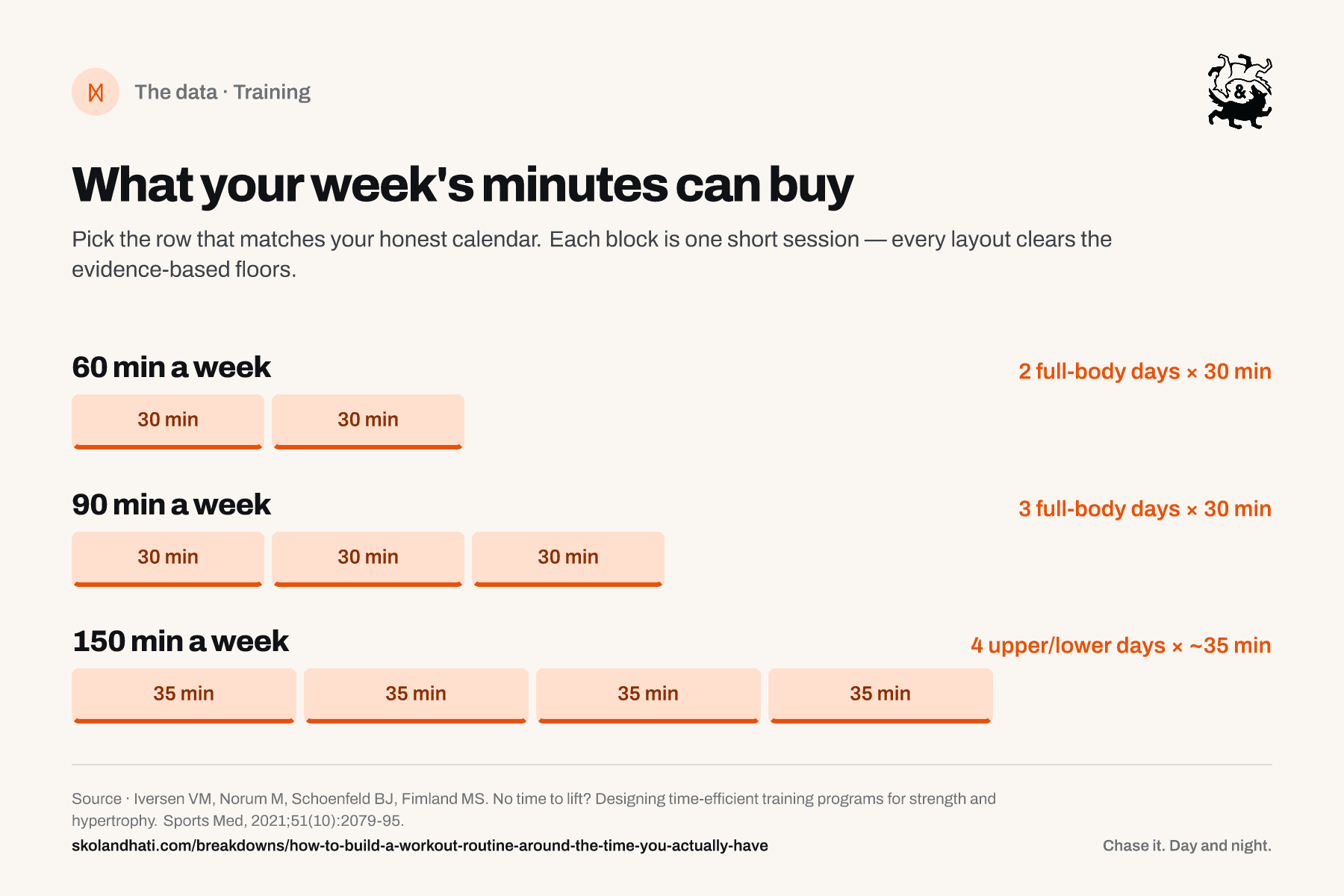
With about 90 minutes a week, three 30-minute full-body sessions reach every muscle two or three times and clear the four-set weekly floor [2][4]. With 150 minutes, four upper/lower sessions can push toward the 10-plus weekly sets where the growth curve keeps climbing [3]. The one popular layout the evidence argues against is the split that touches each muscle once a week [4].
The exercise list can be short. The time-efficiency review's core recommendation is three movements: one leg-pressing exercise like a squat, one upper-body pull, one upper-body push, using machines or free weights as available [2]. That trio reaches almost everything worth reaching. A 30-minute slot spent on those three, worked hard, is a complete session — not a compromised one.
If only the weekend exists
In a cohort of 350,978 US adults, people who packed the recommended activity into one or two days had death rates similar to people who spread it across the week, once total volume was matched [8]. Cramming is evidence-based, not a compromise. Two honest weekend hours are a real program. The muscle caveat stands — growth data favor spreading sets out [4] — but the health outcomes appear to follow the total.
04How do you fit the plan to your body?
Same minutes, different settings. Training age sets your starting volume, age past 60 raises the cost of keeping muscle [10], and injuries redirect sessions rather than cancel them.
Two people with identical calendars should not run identical plans. If you are new to lifting, the minimums above sit close to optimal — the minimum doses above were established in trained lifters [1], so if you're newer, they sit close to optimal. If you have trained for years, treat the minimums as a floor and let your minutes negotiate toward the higher set counts the dose-response data reward [3].
Age moves the maintenance math. In a 48-week trial, adults aged 60–75 lost muscle size on reduced training doses that fully preserved it in 20-to-35-year-olds [10]. Past 40, the honest move is not heroics; it is defending your floor more jealously. Muscle after 40 runs that arithmetic in full. This is what training for the decades means in scheduling terms.
Injuries and recovery set the last dials. A cranky back or knee usually redirects a session rather than cancels it — the bad-back protocol is the template for training around, not through. Recovery is part of the dose, too: rest days count as programming, not absence. On days you arrive flat, keep the slot and drop the load a notch, leaving a rep or two in reserve. Calibrating that feel is a skill of its own, and it gets its own article.
05What do you do when the week collapses?
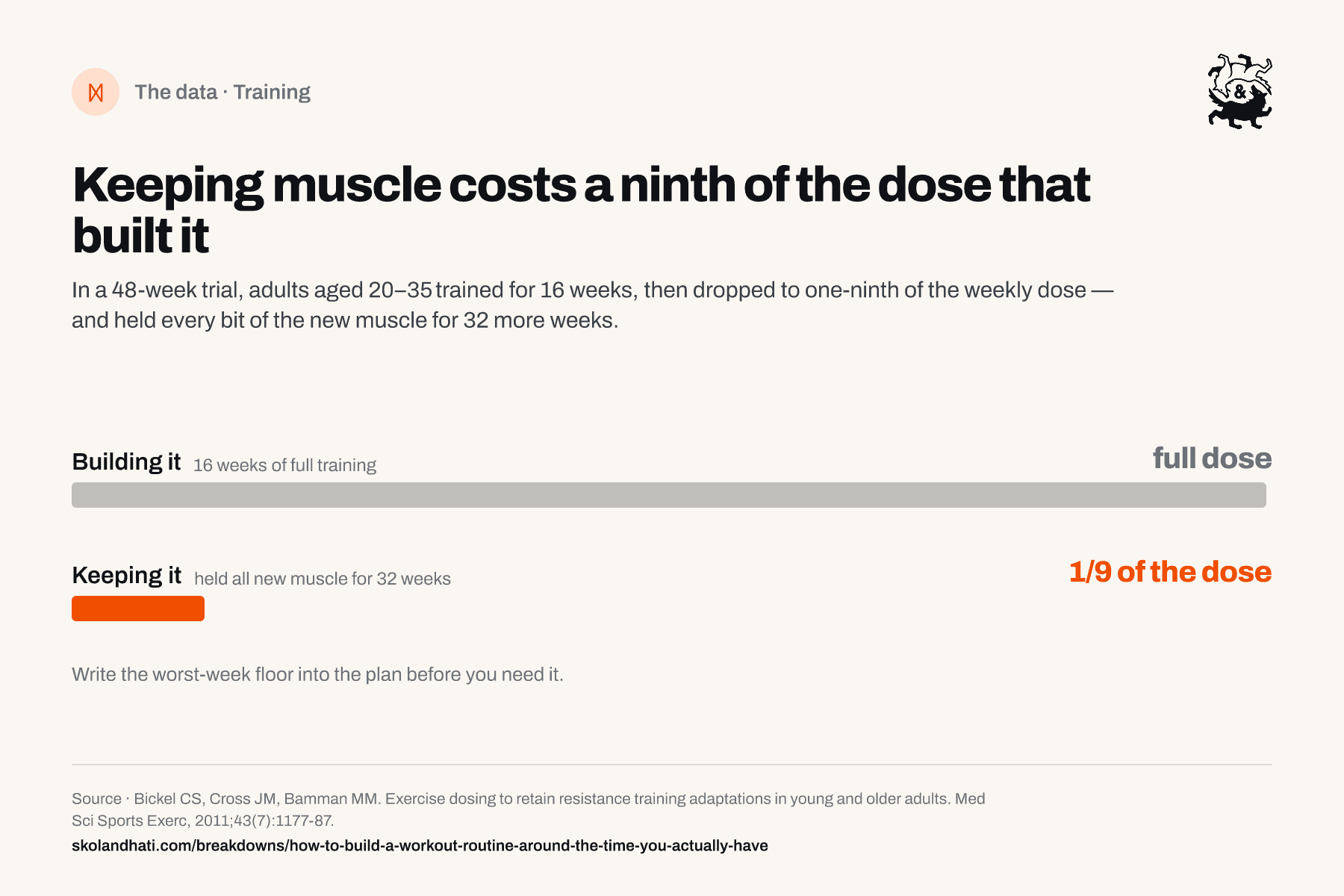
Hold a floor, not the plan. One-ninth of the original training dose held newly built muscle for 32 weeks in younger adults [10].
Missed weeks are not a failure state. They are the base case a schedule-first plan is built for, and the maintenance research is the calmest reading on the subject. In a 48-week trial, people trained for 16 weeks, then cut back. In the younger group, one-ninth of the original weekly dose held all the new muscle for 32 more weeks [10]. Strength was largely retained even in the group that stopped entirely [10]. Fitness behaves like a pilot light: it will not heat the house, but nothing has to be relit.
So write a worst-week floor into the plan before you need it: one 15-to-20-minute full-body session, a few hard sets for the big muscles. That single session sits inside the published evidence for holding, and even building, strength [1][10]. The week your kid brings a stomach bug home, the floor is the plan — not a diminished version of it.
Below even that, minutes still count. Among 25,241 non-exercisers wearing movement sensors, about three one-to-two-minute bursts of vigorous everyday effort per day — stairs at pace, the fast carry — were associated with 38–40% lower all-cause mortality over 6.9 years [9]. That is observational, not a program. But it says the gap between zero and almost-zero is large, and almost-zero fits inside anyone's collapsed week.
One rule makes re-entry easy: come back at the floor, not at the plan. After a lost fortnight, the first session back is the 15-minute version, and the second one probably is too. Nothing in the maintenance data suggests urgency [10]. The schedule-first plan treats collapse and return as ordinary gears, which is why it survives years that gym-first plans do not.
06How do you progress without adding time?
Turn dials inside the slot: reps, load, density. Adding reps at a fixed load grew muscle about as well as adding load [11].
Progression does not require longer sessions. In an eight-week trial of 43 trained lifters, a group that added repetitions at a fixed load matched a group that added load for muscle growth, with only a slight strength edge for adding load [11]. Progressive overload works like tuning a guitar string: a quarter-turn each week — one more rep, one small plate — changes the pitch without changing the instrument. Light or heavy, both directions work when the sets are hard.
Density is the second dial. Supersets, drop sets and rest-pause work roughly halve session time at the same volume, with the caveat that these methods suit muscle growth better than maximal strength [2]. The same review recommends skipping long general warm-ups in favor of a light set of the exercise you are about to do [2]. That is free time, recovered from inside the session.
And when a slot does eventually grow, spend it on sets before anything else. Each weekly set added was associated with measurably more muscle in the dose-response data [3]. The plan's shape never has to change — only the numbers written inside it.