
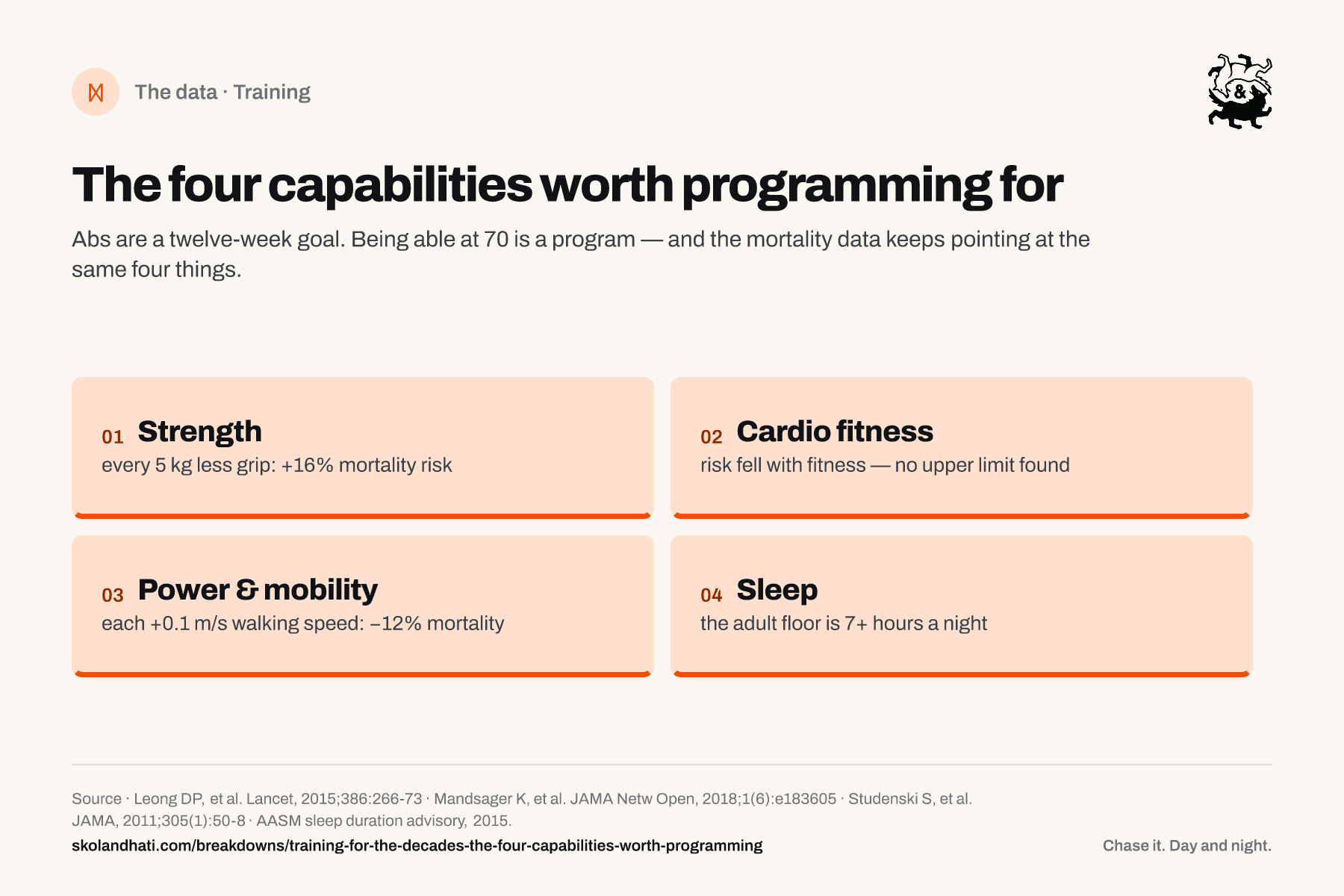
Aging well is a training question with four answers: strength, cardio fitness, power and mobility, and sleep. Each shows its own link to mortality — grip strength, treadmill fitness, walking speed, even getting off the floor [1][3][4][5]. The weekly floor is 150–300 minutes of cardio plus two strength days [6]. The enemy is not one bad year. It is drift.
01What does training for the decades actually mean?
It means programming for what you want to still do at 70 — and the evidence points to four capabilities, not one, each fading on its own schedule.
Most programs are written for the next twelve weeks: a number on the bar, a shirt size. Training for the decades asks a different question. What do you want to still be able to do at 70? Carry luggage up the stairs. Get off the floor without a plan. Say yes to the hike. Those are capabilities, and capabilities can be programmed — the same way a race or a lift can.
The research keeps sorting those capabilities into four piles: strength, cardio fitness, power and mobility, and sleep. Think of them as the four legs of a kitchen chair. The chair does not care which leg goes soft; it tips either way. And the numbers behind each leg are not subtle. In one cohort of 122,007 adults, the least-fit group carried about five times the mortality risk of the fittest — a wider gap than smoking showed in the same data [3]. The threat is rarely one bad year. It is drift: stairs that get a little harder every year while nobody is watching.
02Why is strength on the list?
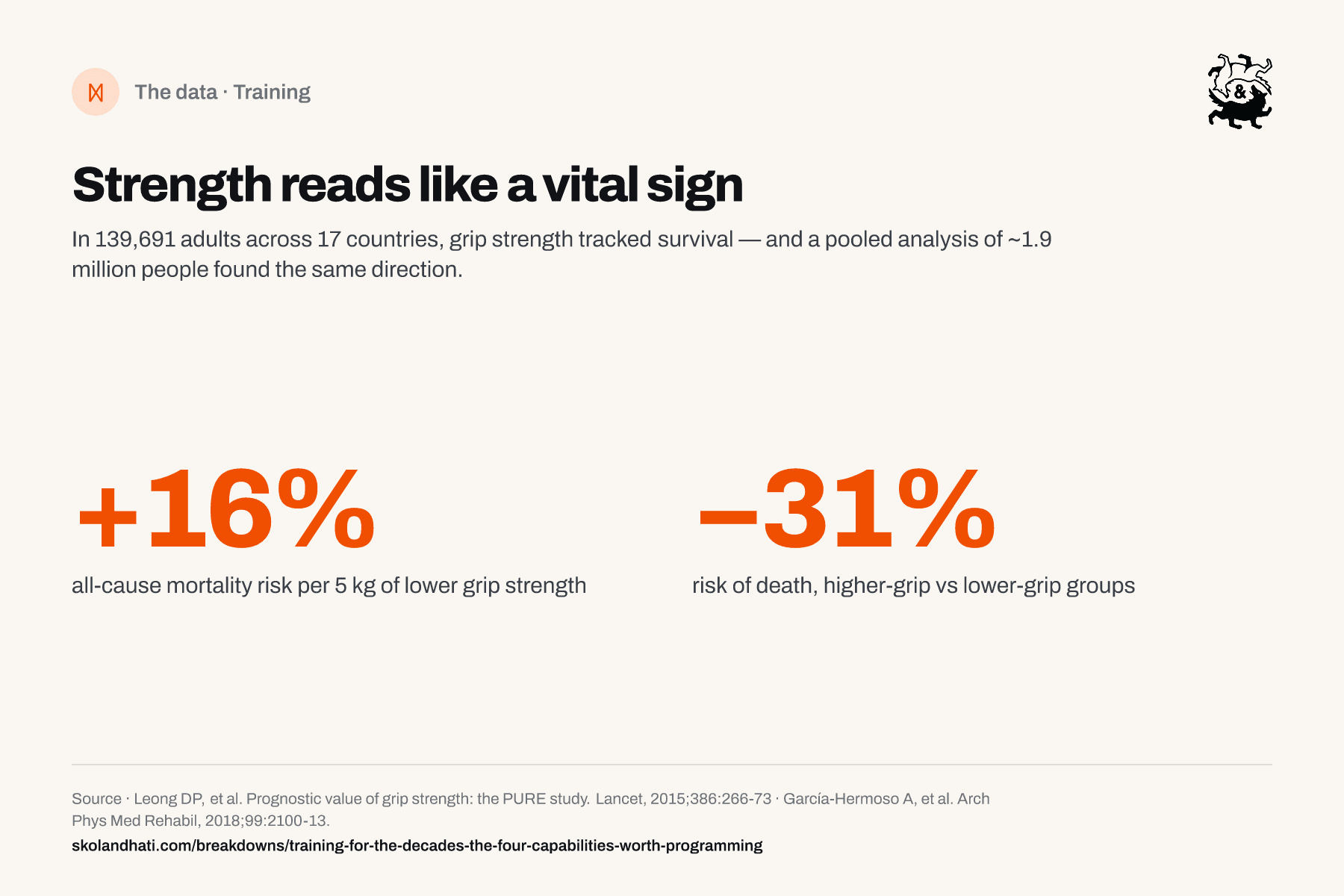
In 139,691 adults across 17 countries, every 5 kg of lower grip strength was associated with 16% higher all-cause mortality [1].
Grip strength is the most-studied strength number because it is cheap to test at scale. In the PURE study — 139,691 adults in 17 countries, followed for a median of 4 years — each 5 kg of lower grip strength was associated with 16% higher all-cause mortality and 17% higher cardiovascular mortality [1]. A meta-analysis of 38 cohorts, close to 2 million people, found the same direction: higher grip strength went with a 31% lower risk of death from any cause, and stronger legs (knee-extension tests) with a 14% lower risk [2].
Honest reading: these are associations. A strong grip is partly a window into total-body reserve — nobody has shown that squeezing a ball changes the outcome. But the pattern is consistent enough that strength earns a permanent slot in the week, not a January cameo. What the number means, and how to test your own in a doorway, is its own article.
By signing up you agree to receive our emails, including occasional offers, and to the privacy policy.
03What does cardio fitness say about your 70s?
Across 122,007 treadmill tests, mortality risk fell step by step with fitness, with no upper limit found — the fittest group did best of all [3].
Cardio fitness is your body's delivery ceiling — how much oxygen it can move when everything is asked to work at once. Picture a kettle: the question is not whether it boils, but how big a flame it can throw when you turn everything up. That ceiling is measurable on a treadmill, and it tracks survival unusually well.
A Cleveland Clinic cohort followed 122,007 patients after treadmill testing for a median of 8.4 years. Risk fell step by step with each fitness band, and the authors found no upper limit — elite performers had about one-fifth the adjusted mortality risk of the least fit [3]. The gap between low and elite fitness was as large as, or larger than, the gaps for smoking or diabetes in the same analysis [3]. Caveat included: these were patients referred for testing, not a random slice of the public, and fitness partly reflects health that is already there. Still, of the four legs, this one shows the steepest curve.
04Why do walking speed and floor tests show up in the mortality data?
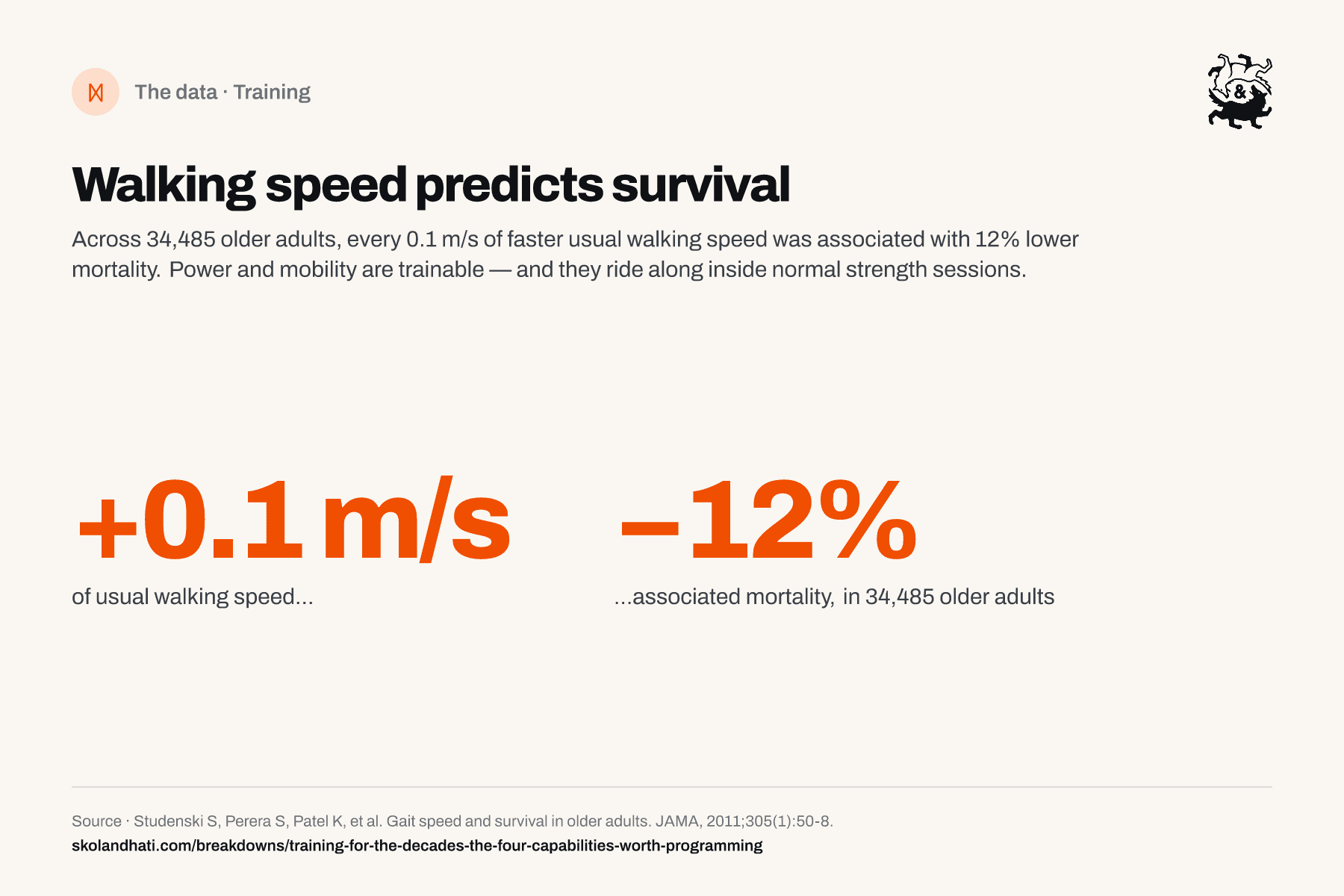
Each 0.1 m/s of faster walking speed was associated with 12% lower mortality in 34,485 older adults — and floor-test scores separated groups even more sharply [4][5].
Strength opens the stuck jar. Power is what catches the glass sliding off the counter — force delivered fast, with balance and coordination attached. The tests that capture this look almost too simple. Walking speed: in a pooled analysis of 34,485 adults 65 and older, every 0.1 m/s of faster gait was associated with 12% lower mortality, across the whole range of speeds [4].
Or sitting and rising from the floor. In 4,282 adults aged 46 to 75, a 0-to-10 score — points lost for every hand or knee used — sorted people cleanly. Over a median of 12.3 years, 3.7% of top scorers died, against 42.1% of the lowest group [5]. The authors call the test a blend of strength, power, flexibility, and balance [5]. These are associations, and slow scores often reflect illness already present. But the practical read stands: the floor and the sidewalk are honest examiners. The floor test is worth taking before it gets interesting.
05Where does sleep fit in a training plan?
Sleep is the fourth leg because adaptation happens between sessions — and the adult floor in the consensus statement is 7 or more hours a night [7].
A workout is a question you ask your body. The answer — new muscle, new capillaries — gets written between sessions, and most of the writing happens while you sleep. That is why sleep sits inside a training article at all: it is the leg of the chair nobody photographs.
The American Academy of Sleep Medicine's advisory puts the adult floor at 7 or more hours per night on a regular basis [7]. This site keeps a whole shelf on the subject, starting with what sleep debt you can pay back and what you can't. For programming purposes the rule is one line long: sleep is scheduled like a session, not collected from what the day leaves over.
06How do you split a week across four capabilities?
The floor is the WHO's: 150–300 minutes of moderate cardio plus strength work on 2 or more days — power and mobility ride along inside those sessions [6].
The WHO's 2020 guidelines set the floor: 150 to 300 minutes of moderate cardio a week (or 75 to 150 vigorous), plus muscle-strengthening work for all major muscle groups on 2 or more days [6]. For adults 65 and up, the guidelines add multicomponent work — balance plus strength — on 3 or more days a week [6]. That is the whole skeleton. Most of your minutes go to easy cardio, because minutes are what that leg eats. Two strength sessions hold the second leg.
The third leg mostly rides along: carry the groceries in one trip, take stairs quickly, stand up from the floor without hands a few times before a session. The fourth is a bedtime. Nobody with a full life hits this every week — missed weeks are the base case, and the program is built to absorb them. The bar is the trend across a season, not any single seven days.
Do I need four separate workouts for four capabilities?
Is it too late to start training at 50?
What is the sitting-rising test?
Does walking count as cardio training?
Which of the four capabilities matters most?
General-audience information — not medical advice. Every figure here is an association from cohort studies — a description of who did well, not a promise of what training will do for any one person. What these numbers mean for you sits inside your whole health picture, which is your doctor's read. General education, not medical advice. How we source and verify. No affiliate links in this breakdown. Published 2026-10-01.
VO2 max: the number that decides what you can do at 70
Your aerobic ceiling, in one number: what it is in plain language, where you stand by decade, how to estimate it without a lab — and how hard it tracks with the long game.
6 min · September 9, 2026TrainingGrip strength: the longevity number you can test in a doorway
One squeeze of a dynamometer tracks with lifespan more strongly than blood pressure does. The norms by age and sex, the honest truth about dead-hang standards, and how grip gets trained by accident.
5 min · September 5, 2026