
One bad night costs less than it feels. Across 69 studies, sleep loss cut exercise performance about 7.6% on average, and morning sessions were largely spared [1]. Single heavy lifts mostly hold; repeated efforts, skill, and how hard it all feels take the hit [2][5]. Show up, trim volume, and pay the sleep debt back tonight.
01Should you still train after a bad night?
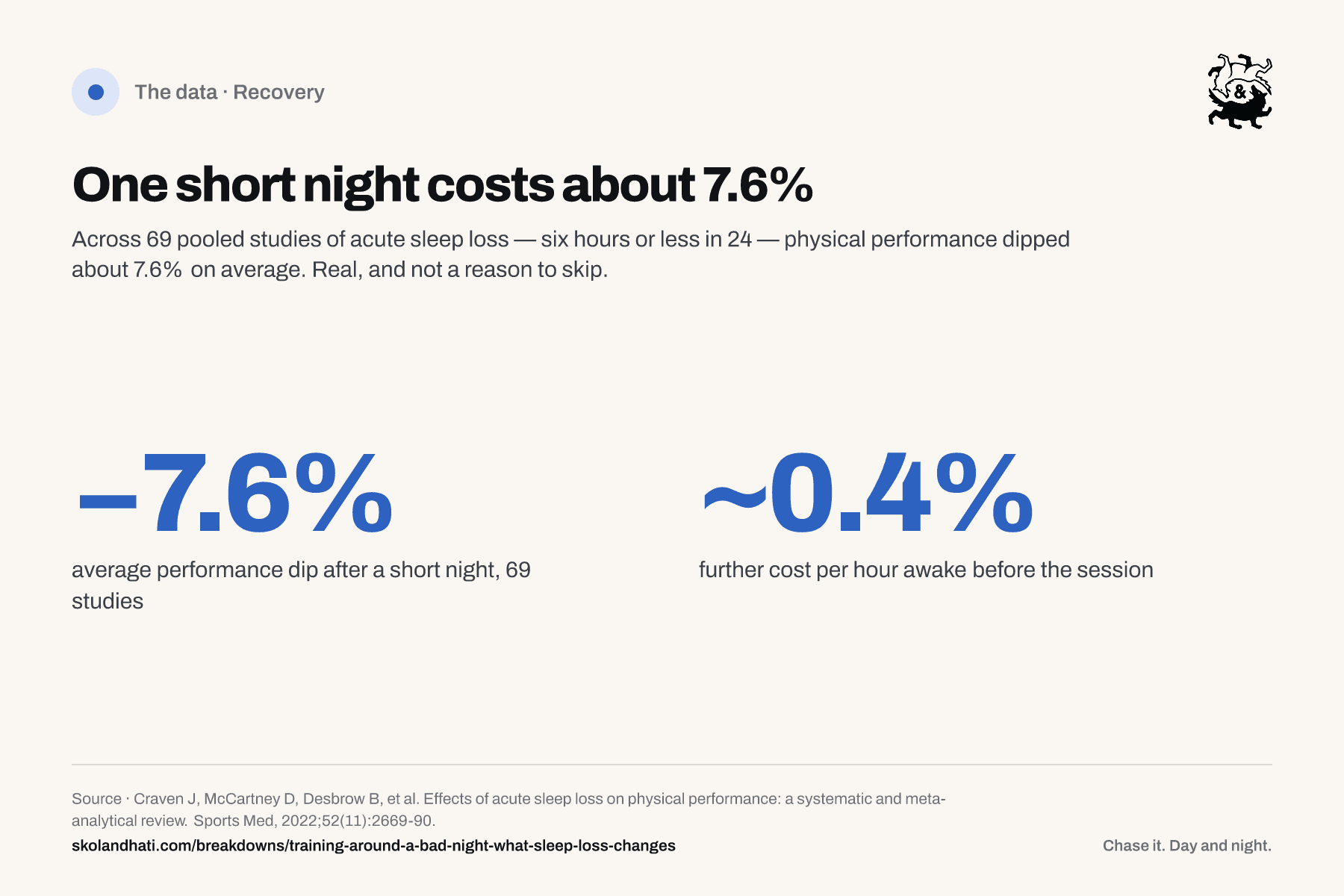
Yes. Across 69 pooled studies, sleep loss cost about 7.6% of physical performance on average — real, but not a reason to skip [1].
First, what counts as a bad night. The largest meta-analysis on this question pooled 69 studies and set the bar at 6 hours of sleep or less in a day [1]. Below that bar, physical performance dropped about 7.6% on average across the tasks tested [1]. That number is real. It is also smaller than the fog in your head at 6 a.m. suggests.
So the base answer is yes — go. A 7.6% dip turns a 100 kg squat day into a 92 kg squat day, not a rest day. The details below decide what kind of session makes sense today. They all sit inside the bigger recovery picture, where sleep is the largest single lever you own.
02What breaks down first, and what survives?
Single maximal efforts largely survive one bad night; skill, speed, repeated efforts, and your sense of effort degrade first [2][5].
A systematic review of resistance training under sleep loss found a clean split. One night of no sleep at all had little effect on maximal muscle strength [2]. Consecutive short nights were different: force fell in multi-joint lifts, like squats and presses, while single-joint moves held up [2]. Think of a squat as a committee decision — brain, balance, and a dozen muscles voting at once. A curl is one worker with one job. Tired committees fail first.
The wider numbers agree. A 2025 meta-analysis of 45 trials found the largest losses in skill control, with endurance and explosive power close behind and maximal force losing the least [5]. It also found that rated effort climbed significantly after sleep loss [5]. Nothing got heavier; the price tag on every rep went up. Worth remembering before you take today's RPE reading at face value.
An earlier review reached the same shape from the other side: some maximal efforts and gross motor skills can be maintained after sleep loss, while sport-specific performance tends to drop [4].
By signing up you agree to receive our emails, including occasional offers, and to the privacy policy.
03Is morning training better after a bad night?
Yes. In the pooled data, morning tasks were largely unaffected, while afternoon and evening performance dropped consistently [1].
The clock matters more than the barbell. Tasks performed in the morning were largely unaffected by sleep loss, while afternoon and evening tasks took consistent hits [1]. Performance fell roughly 0.4% for every hour spent awake before the session [1]. Wake at 5 a.m. and train at 6, and you have paid one hour of that tax. Wait until 6 p.m. and you have paid thirteen.
How the night got cut matters too. Losing the back end of the night — waking far earlier than normal, or not sleeping at all — showed consistent harm [1]. A late bedtime with a normal wake time was less consistently costly [1]. If tonight's choice is a late bedtime or a brutal alarm, the data leans toward the late bedtime.
04Does one bad night raise injury risk?
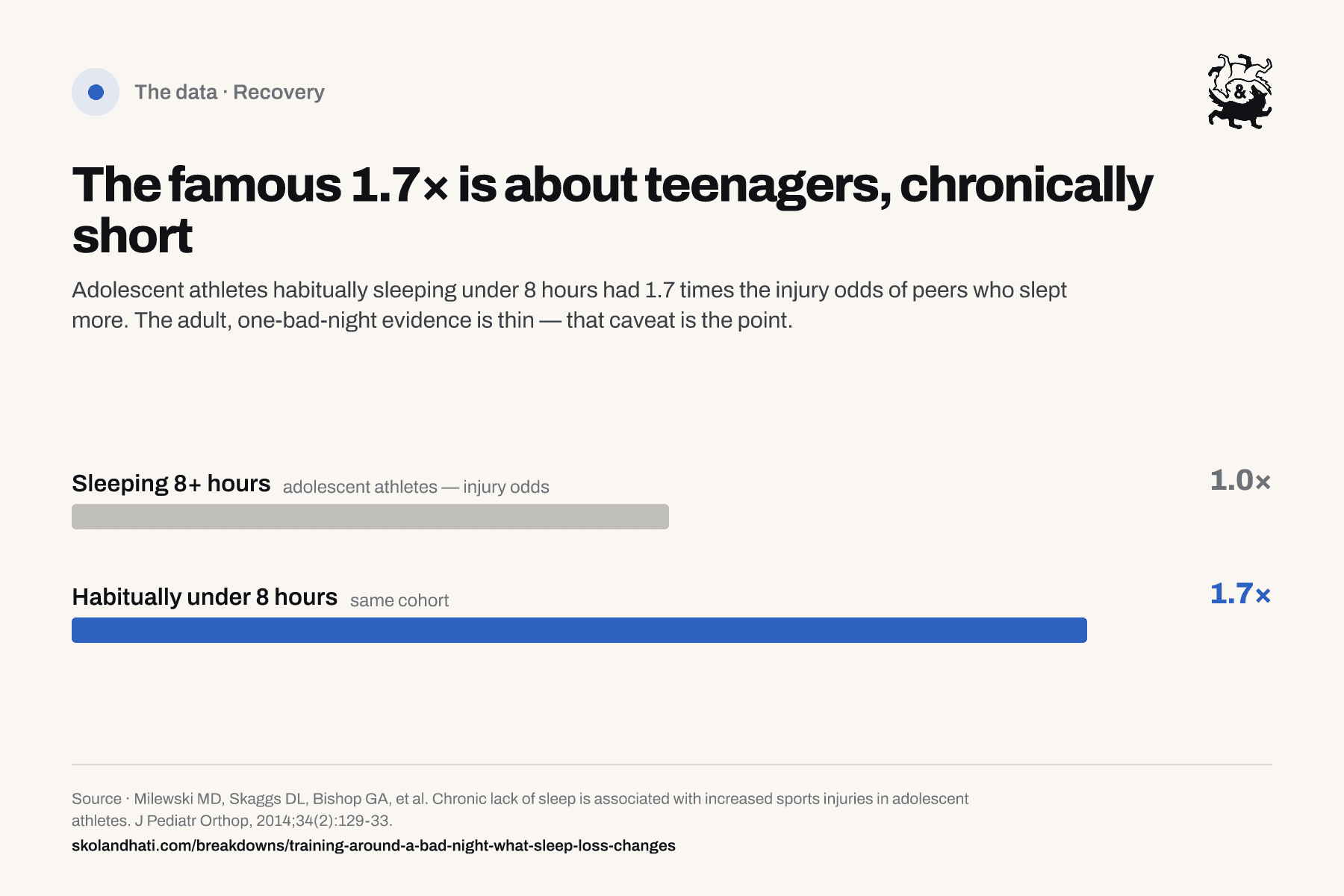
The famous 1.7x figure comes from adolescent athletes who were chronically short on sleep — the adult, one-night evidence is thin [3].
The most-quoted injury number here deserves an honest label. In a survey of 112 adolescent athletes, ages 12 to 18, those averaging under 8 hours of sleep were 1.7 times more likely to have been injured than those sleeping 8 or more [3]. That is teenagers, habitual short sleep, and a look back through school injury records — an association, not a verdict on your Tuesday. No comparable figure exists for a 40-year-old after one rough night. That evidence is simply thin, and it is fairer to say so than to borrow the teens' number.
What the adult research supports is indirect. After sleep loss, reviews describe slower and less accurate thinking, and a nervous-system imbalance that can resemble overtraining symptoms [4]. Add the measured losses in skill control [5], and there is a reasonable case for skipping the technical, high-consequence work today — max attempts, new movements, anything where a sloppy rep costs you.
05What should today's session look like?
Show up, keep the main lift, cut the volume, push the hard interval day back, and defend tonight's sleep.
Show up, and show up early if you can [1]. Keep the first big lift — single efforts are the part that survives [2]. Then cut volume, not the session: drop the back-off sets, trim the accessories, and leave the grinding rep-out work for another day. The session you do at 92% beats the one you skip.
Move the hard interval day rather than muscling through it. Repeated efforts and skill work degrade first [5], so swap today's intervals for easy aerobic work and push the hard day back 48 hours. Two practical props from the resistance-training review: caffeine, and training with other people — both were flagged as ways to shore up motivation when sleep is short [2].
The worst version of this week is not hypothetical. You were up from 2 to 5 a.m. with a feverish kid, and the plan says intervals. The plan is wrong now, and that is fine — a 20-minute easy spin plus one big lift is a full pass, and a skipped day is ordinary too. The move that matters most is guarding tonight, because the strength losses in the research came from consecutive short nights, not single ones [2]. If the nights keep breaking anyway, there is a protocol for interrupted nights built for exactly that.

Should I work out on 4 hours of sleep?
Does one night of bad sleep ruin muscle growth?
Is it safe to lift heavy after no sleep?
Morning or evening workout after a bad night?
How many bad nights until it shows in the gym?
General-audience information — not medical advice. One bad night is general-audience territory. Ongoing broken sleep, loud snoring, or feeling unwell rather than tired is your doctor's territory. This page reports group averages from research — education, not a green light for any particular day. How we source and verify. No affiliate links in this breakdown. Published 2026-10-12.
Sleep debt: what you can pay back, and what you can't
The part you can recover, the part you can't, and why weekend catch-up only pays half the bill.
5 min · September 5, 2026SleepBroken sleep: the interrupted-nights protocol
What fragmentation actually costs, what to protect when the night is already lost, and what a wrecked night really does to the next morning's session. Written for the parent at the bedroom door, not the biohacker.
5 min · September 5, 2026