
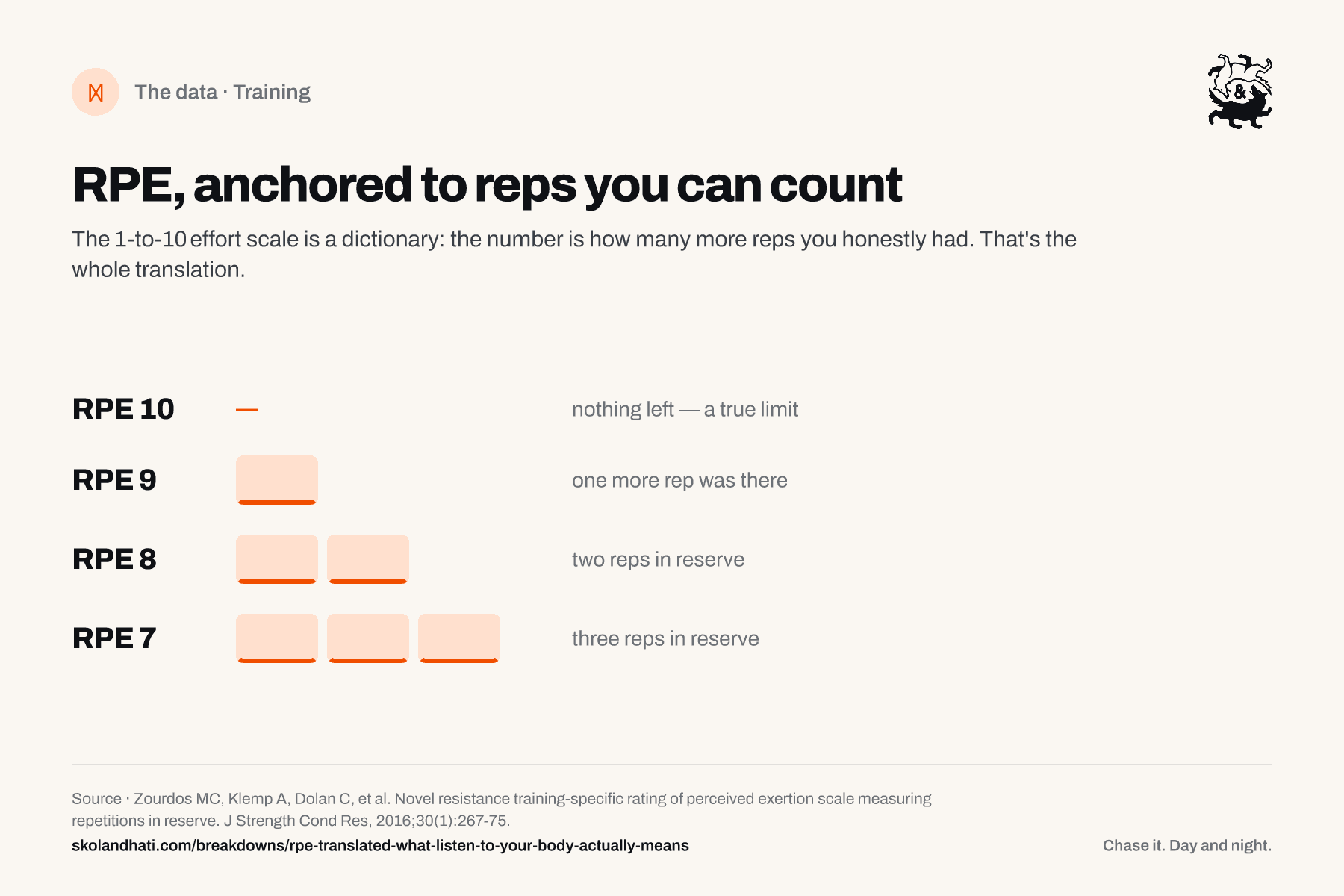
“Listen to your body” has a working version: RPE, a 1-to-10 effort scale where 10 means nothing left and 8 means two reps in reserve [1]. People guessing what's left run about one rep conservative [3]. In a 12-week trial, choosing loads by feel beat fixed percentages for strength [4]. It's the most portable tool in training.
01What does RPE actually mean in the gym?
RPE is a 1-to-10 effort scale anchored to reps in reserve: 10 means nothing left, 9 means one more rep was there, 8 means two [1].
RPE stands for rating of perceived exertion. The original scale was built for cardio half a century ago. The lifting version, validated in 2016, ties each number to something you can count: reps in reserve, or RIR [1]. RPE 10 means you had nothing left. RPE 9 means one more rep was there. RPE 8 means two. Below about RPE 7, the anchors loosen into general effort, because guesses get fuzzy far from failure [2].
This isn't hand-waving dressed up as a number. In the validation study, 29 squatters reported RPE while their bar speed was recorded [1]. The bar slowed as reported effort climbed — a correlation of r = −0.88 in experienced lifters and −0.77 in novices [1]. Experienced lifters also called a true max a max: they rated a 1RM at 9.8 on average, while novices rated the same all-out lift 9.0 [1]. RPE doesn't replace your program. Rep ranges still set the goal; RPE decides how heavy today's version of it gets.
02How accurately can you guess reps in reserve?
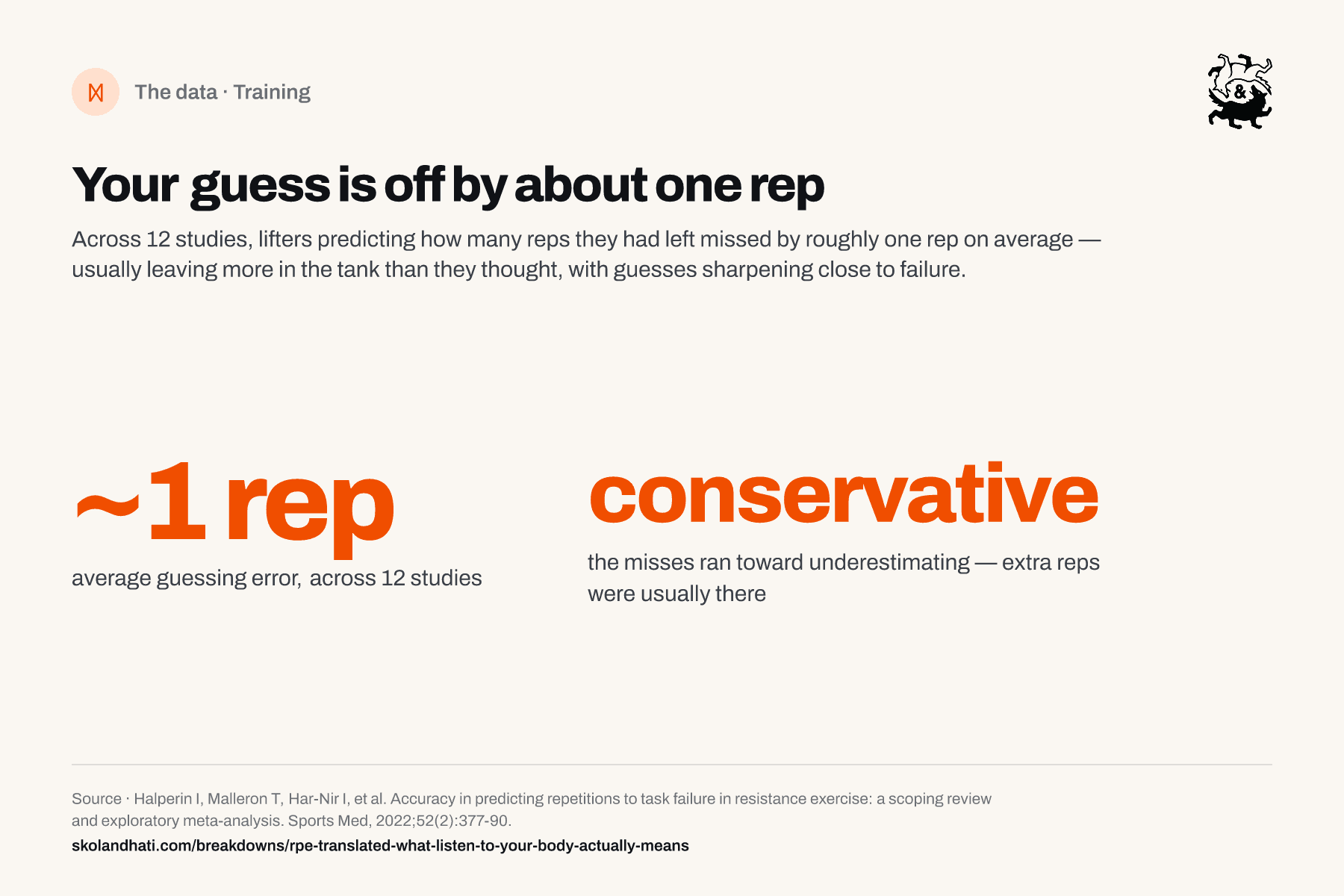
Within about one rep, on average. Across 12 studies, people underestimated what was left — and guesses sharpened close to failure [3].
A 2022 meta-analysis pooled 12 studies in which 414 people stopped mid-set, guessed what remained, then kept going to failure [3]. The average miss was 0.95 repetitions — about one rep, and in the conservative direction. People had more left than they claimed. Guesses were sharper with heavier loads, and improved as the stopping point moved closer to actual failure [3].
Here's the surprise: in that pooled analysis, training experience made no meaningful difference to accuracy [3]. You don't need a decade under the bar. In one study of bodybuilders, estimates of remaining reps tracked reality at r = 0.95 on the bench press and r = 0.93 on the squat — and each successive set brought the guesses closer [2]. Calibration is a drill, not a talent. The version Helms and colleagues recommend is simple: log your RIR call, then occasionally take the same load to failure and compare [2]. A few honest checks tune the gauge.
By signing up you agree to receive our emails, including occasional offers, and to the privacy policy.
03Is training by feel better than fixed percentages?
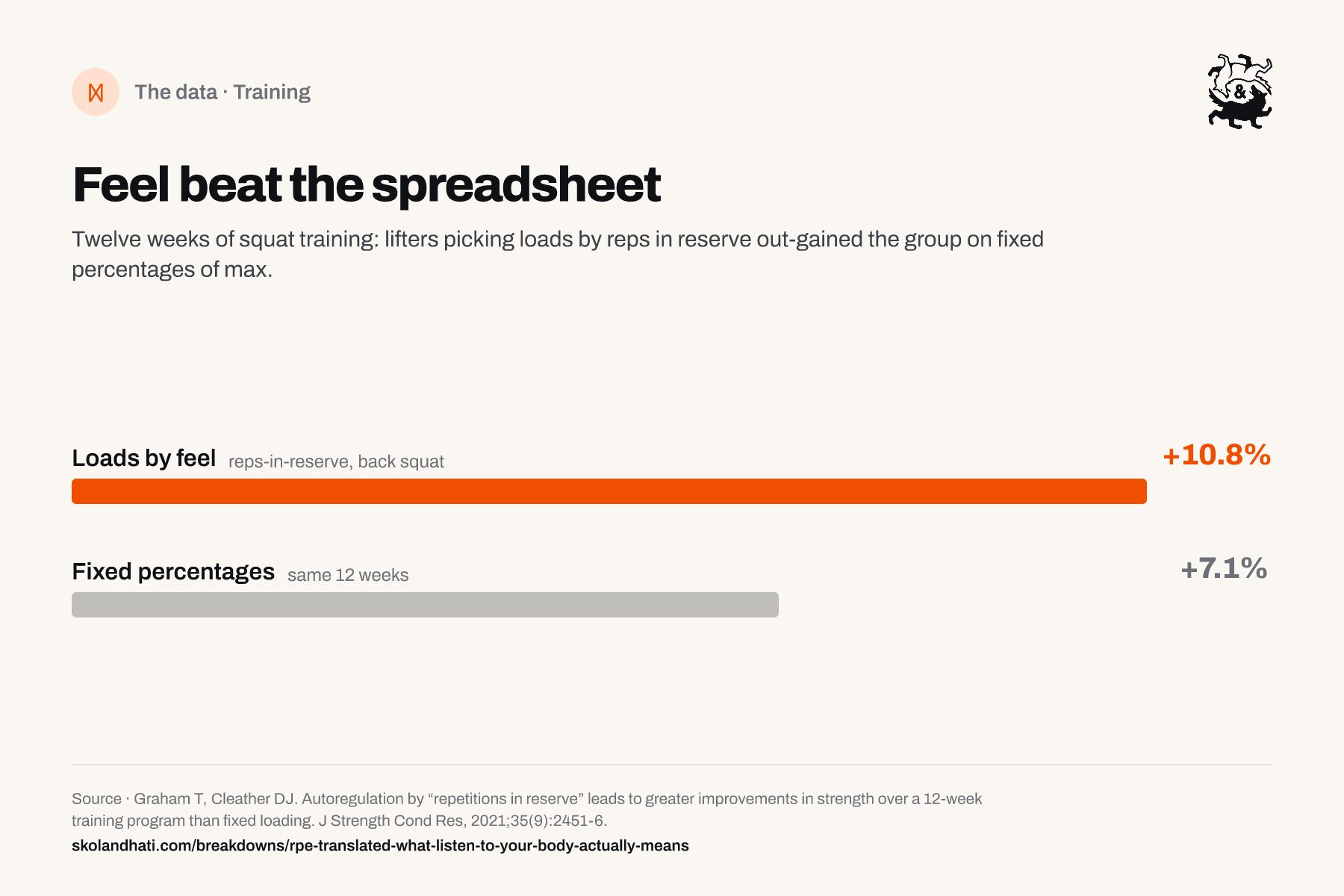
In a 12-week trial, lifters picking loads by reps in reserve gained 10.8% on the back squat; the fixed-percentage group gained 7.1% [4].
Percentage-based programs treat your 1RM as a stable fact. It isn't. Strength drifts day to day with sleep, stress, and food, and a test-day number can flatter or shortchange you [2]. A fixed percentage is a heating schedule that ignores the weather. RPE is the thermostat: the same target, adjusted for the room you actually woke up in.
The comparison has been run. Thirty-one trained lifters followed identical 12-week programs — same sets, same reps — except one group loaded by fixed percentages and the other by reps-in-reserve targets [4]. The RIR group added 10.8% to the back squat versus 7.1%, and 11.7% to the front squat versus 8.3% [4]. Note the direction of the mechanism. The by-feel group ended up training slightly heavier, around 83% of 1RM on average against 80% [4]. Feel is not a license to coast. And on a rough week — the kind your body keeps a ledger of — the same rule trims the load without scrapping the session. Messy weeks are the base case for anyone with a full life. A loading rule that absorbs them beats one that assumes they won't happen.
04Does RPE work for cardio and conditioning too?
Yes. Session RPE — one 1-to-10 rating times minutes — held up as a load measure across steady rides, intervals, and basketball practice [5].
For everything that isn't a barbell, there's an even simpler version, published by Carl Foster's group in 2001 [5]. About 30 minutes after you finish, answer one question: how hard was that, 1 to 10? Multiply by the minutes [2][5]. A 45-minute ride that felt like a 4 scores 180. It works like a grocery receipt: quantity times price is what the session cost you.
Foster's team lined this single rating up against a load score built from heart rate, across steady cycling, interval sessions, and basketball practice [5]. The two scores moved together consistently in every mode, though the RPE version ran higher in absolute terms [5]. That mode-independence is the point. A lifting session, a run, and an evening of chasing your kid around the yard can all land in one ledger. Numbers you can add are numbers you can budget — the same logic as a weekly set budget for lifting.
What does RPE 8 mean?
Are beginners bad at judging RPE?
Is training by feel just an excuse to go light?
What RPE should working sets hit?
General-audience information — not medical advice. This page is general education about effort scales, not individual programming or medical advice. Pain is not high RPE — pain that changes how you move is a stop-and-ask question, and a clinician's territory. How we source and verify. No affiliate links in this breakdown. Published 2026-10-05.
Light or heavy: what rep ranges actually change
Near failure, light and heavy build the same muscle. Heavy buys one specific thing. The zone is wider than the feed sells.
5 min · September 5, 2026TrainingThe weekly set budget: how many sets actually build muscle
Sets per muscle per week is the currency of growth. The floor, the solid-return zone, and the line where extra sets turn to junk.
5 min · September 5, 2026