
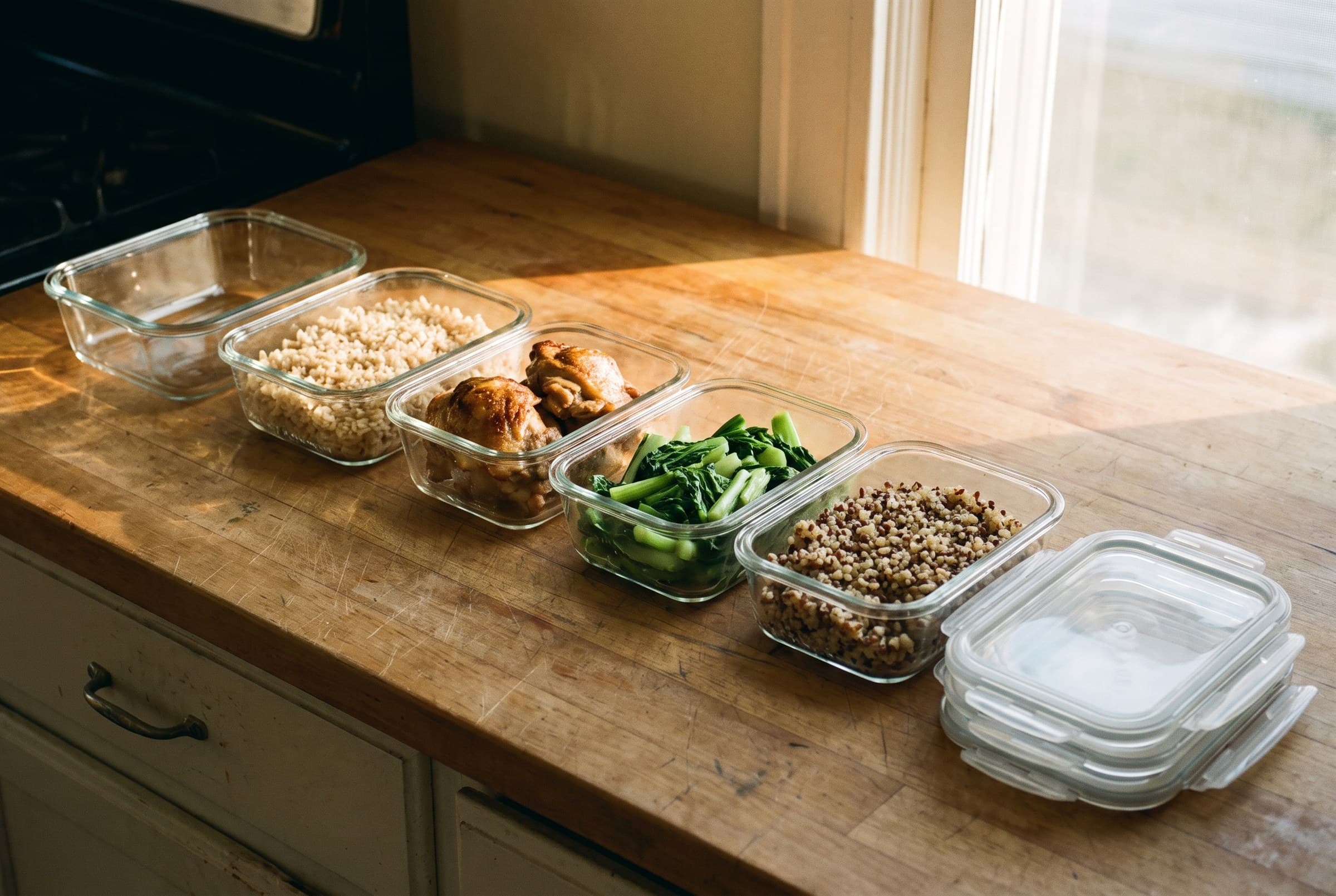
One 90-minute Sunday session — rice cooker, two sheet pans, five containers — covers the week's lunches at 35–45 g protein each. USDA figures: 150 g cooked chicken thigh carries 37 g, 140 g breast carries 43 g. Cost lands near $3 a container, and cooked food keeps 3–4 days in the fridge — so Friday's goes in the freezer.
01How much protein goes in each container?
Weigh cooked portions once — 140 g of roasted breast or 150 g of thigh puts 37–43 g of protein in a container [1].
Target 35–45 g per lunch. If your daily number is around 1.6 g/kg — the protein-math breakdown gets you there — a midday meal carrying 40 g means dinner and breakfast only have to be decent, not heroic.
The portions below are cooked weights, from USDA FoodData Central [1]. Roasted chicken breast runs 31 g of protein per 100 g; boneless thigh runs 24.8 g; pan-broiled 90/10 ground beef runs 25.2 g. A kitchen scale turns those densities into portions once, and the containers remember for you after that.
02What does the 90-minute workflow look like?
Nothing needs watching, so it all runs in parallel — 90 Sunday minutes cover five weekday lunches.
The trick is that nothing here needs watching, so everything runs in parallel: the rice cooker owns the starch, the oven owns the meat and vegetables, and a slow cooker — optional — owns next week's chili while you're at it. A 2.5 lb pack of boneless thighs cooks down to roughly 800 g: five 150 g portions with change.
Ninety minutes sounds like a lot until you price the alternative: five separate 20-minute lunch decisions, made hungry, at whatever's nearest the office. The Sunday version happens while the kids watch a movie.
By signing up you agree to receive our emails, including occasional offers, and to the privacy policy.
03What does it cost compared with buying lunch?
One receipt lands near $3 a container against a $12–15 bought lunch, and frequent home cooks spend less per month while eating better [3].
Run one receipt: 2.5 lb of thighs at $2.99/lb is about $7.50; 2 cups of dry rice about $0.80; 2 lb of frozen vegetables about $4; oil and sauce call it $1.50. Roughly $14 for five containers — under $3 each, against the $12–15 a bought lunch runs. Your prices will differ; the ratio won't.
The population-level data agrees with the receipt. In the Seattle Obesity Study (437 adults), the most frequent home cooks spent less on food overall than the least frequent — $273 versus $330 per person per month — while eating measurably better; frequent restaurant eaters spent more and scored worse [3].
04How long do the containers actually keep?
Cooked food keeps 3–4 days in the fridge, so Friday's container goes to the freezer on Sunday night [2].
Here's the part meal-prep influencers mumble: USDA gives cooked leftovers 3–4 days in the refrigerator [2]. Sunday cooking covers Monday through Thursday. Friday's container belongs in the freezer on Sunday night — frozen, it's safe more or less indefinitely, and it moves to the fridge Thursday evening.
Two more lines of fine print worth respecting: food should reach the fridge within 2 hours of cooking — cool the pans, don't let them sit out through bedtime negotiations — and reheated leftovers should hit 165 °F [2]. A microwave does this; stirring halfway helps it do it evenly.

05Does meal prep actually change how you eat?
Among 40,554 adults, meal planners ate a wider variety and carried lower odds of obesity — an association, but a consistent one [4].
The habit shows up in the data, not just the fridge. Among 40,554 adults in the French NutriNet-Santé cohort, people who planned meals ahead ate a wider variety of food, tracked closer to dietary guidelines, and carried lower odds of obesity — an association, not a guarantee, but a consistent one [4].
The mechanism is boring and that's the point: the decision gets made once, on Sunday, by the version of you who isn't hungry. Tuesday-you just opens the fridge. Pair the containers with the maintenance-calories breakdown and the week's food runs itself — more of the same arithmetic lives on the nutrition shelf.
Doesn't the chicken get sad by Thursday?
Breast or thighs?
Do I really need a kitchen scale?
General-audience information — not medical advice. How we source and verify. No affiliate links in this breakdown. Last updated 2026-09-05.
Protein math for people who cook twice a week
The daily target, split across meals you'll actually eat. Plain numbers, no powder required.
4 min · September 5, 2026NutritionMaintenance calories without an app
Two honest ways to find the number — a formula you can do on paper, and a bathroom scale that outranks it. No wearable required.
5 min · September 5, 2026