
Pooled trials find fitness apps add roughly 1850 steps a day at first [3]. The catch is time: dropout in the nearest large estimate runs 43% [5], and average effects roughly halve at long-term follow-up [4]. The app that works is the one still open in month three. In your numbers, an app is a nudge — not an engine.
01Do fitness apps actually get people moving?
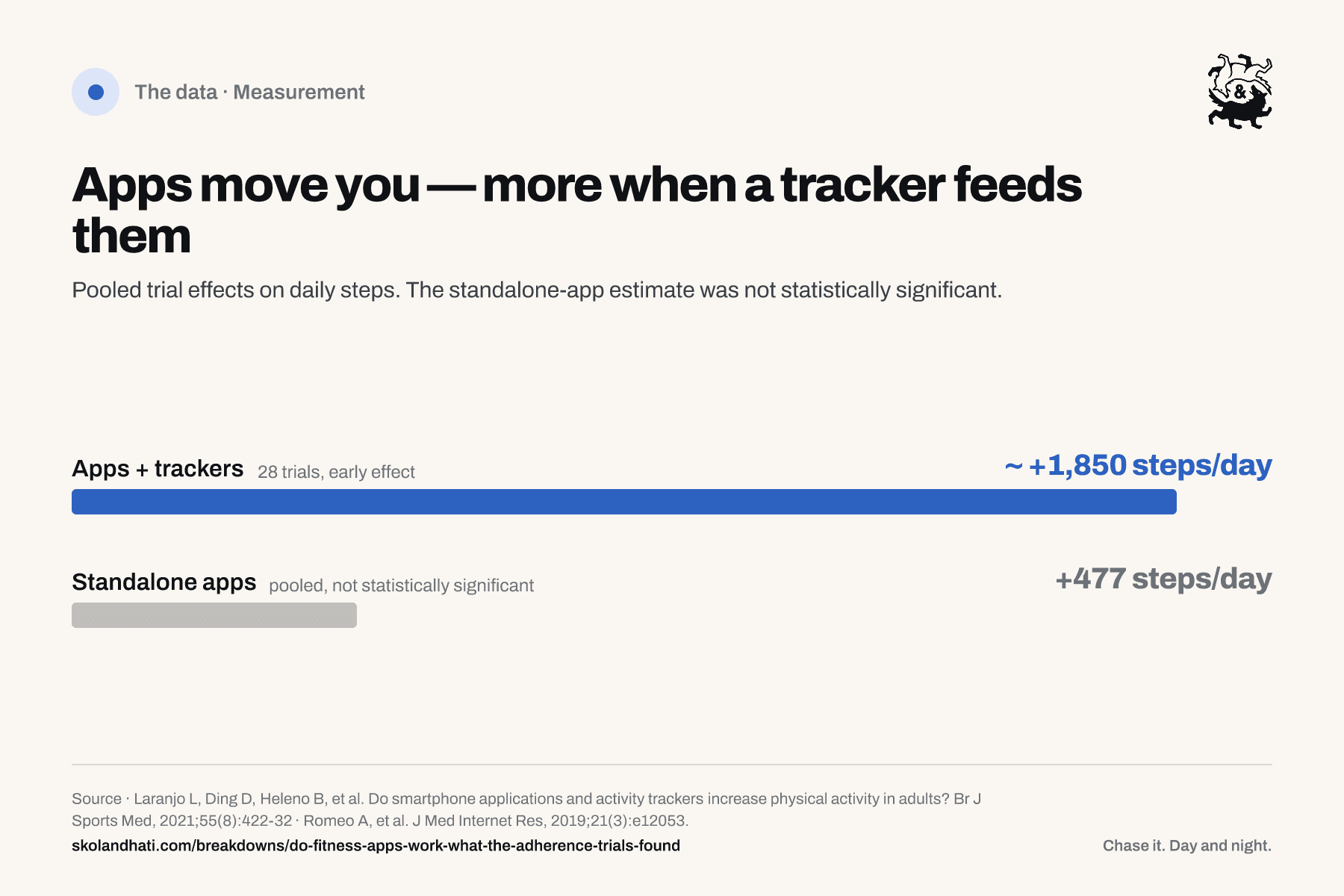
Yes, modestly. Pooled trials of apps and trackers find an early bump of roughly 1850 steps a day — real movement, not a new life [3].
The fair way to answer is a meta-analysis — pooling many trials into one estimate, like averaging every thermometer in the house instead of trusting one. The largest focused pooling of app and tracker trials in healthy adults covered 28 randomized trials and 7454 people [3]. Its answer: a small-to-moderate boost, translating to about 1850 extra steps a day, with a range of roughly 1250 to 2450 [3]. An earlier pooling of 18 trials landed in the same small-to-moderate territory for daily activity minutes and steps [2].
The picture dims when the app has to work alone. A meta-analysis restricted to standalone apps — no coach, no tracker, no program around them — found a gain of about 477 steps a day that was not statistically significant [1]. And the biggest review of the field, 117 trials and 21,118 people, found small-to-moderate effects while rating 8 in 10 trials at high risk of bias [4]. So the honest average is: apps help, the help is modest, and the studies flatter them.
02Why does the effect fade after three months?
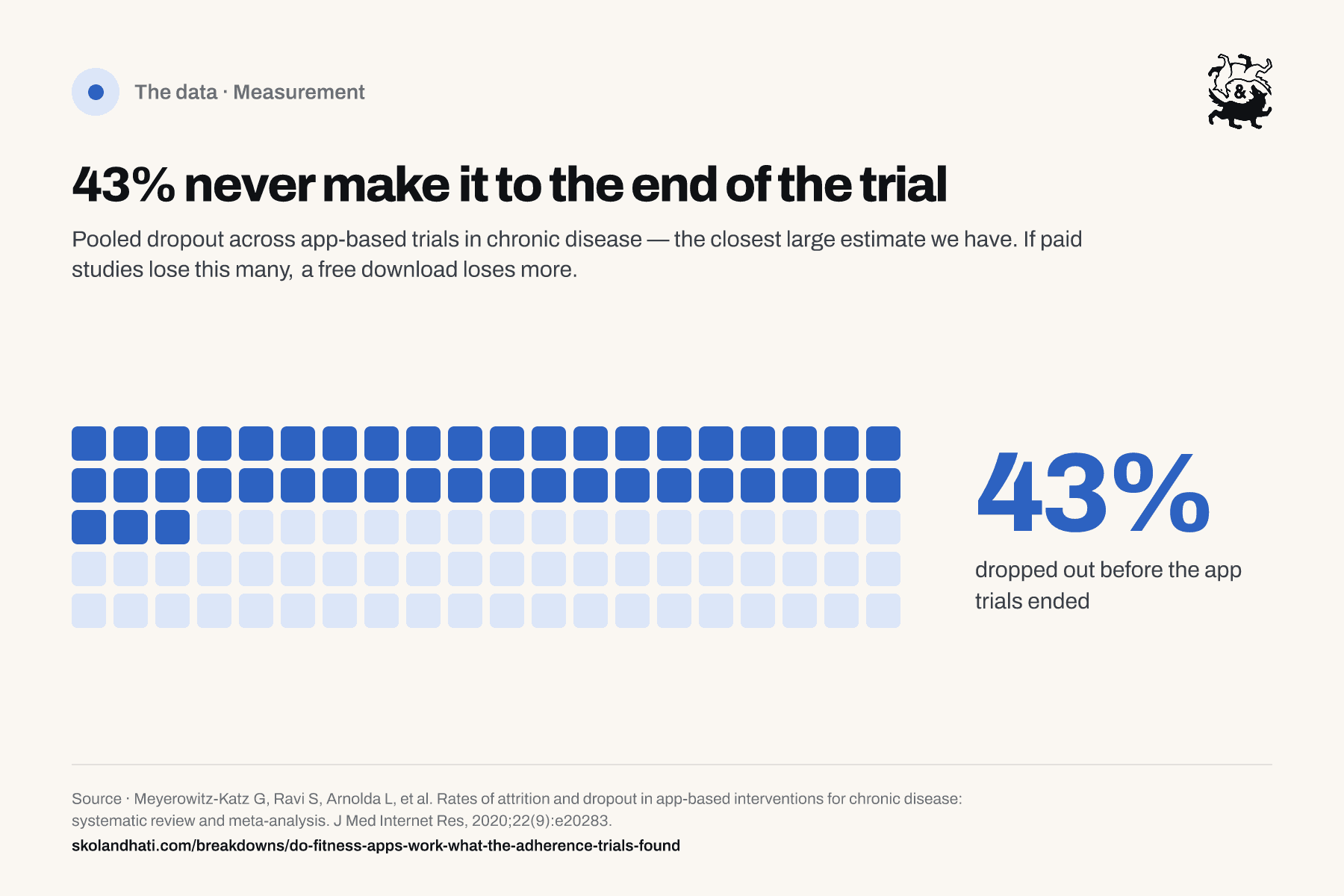
Because use fades first. Pooled dropout in app trials is 43%, and average effects shrink to about half at long-term follow-up [4][5].
Across 17 app studies, the pooled dropout rate was 43% — nearly half of everyone who started [5]. That was inside studies, where people get reminders and check-ins. In the observational studies closer to real life, dropout ran 49%; in tightly run trials, 40% [5]. Most apps age like the spice blend you bought for one recipe: heavy use for two weeks, then the back of the drawer. That arc is the base case, not a personal failure — trials are full of people who stopped.
The effects follow the usage down. Programs shorter than 3 months outperformed longer ones in one meta-analysis [1]. In the 117-trial review, the average walking effect at the end of a program was about half its size again at follow-up beyond six months [4]. Effects did persist — smaller, but present [4]. Which reframes the shopping question: not which app looks best in week one, but which one you would still open in month three. A minimal log you'll actually keep beats a rich one you'll abandon.

By signing up you agree to receive our emails, including occasional offers, and to the privacy policy.
03Which app features actually matter?
Personal touches beat polish: tailored content and message-style nudges tracked with bigger effects, and game features added a real edge that shrank once programs ended [6].
When researchers asked which ingredients separated stronger trials from weaker ones, the winners were unglamorous. Interventions with text-message nudges and personalization — content adjusted to you, not a generic feed — were significantly more effective in subgroup analyses and meta-regression [3]. Every app in that pooling was built on automated self-tracking with feedback, the workhorse the whole category runs on [3]. That squares with the broader evidence that tracking itself changes results.
What about gamification — points, badges, leaderboards, team challenges? A pooling of 16 trials with 2407 people found it worked: a small-to-medium effect overall, and still an edge over the same programs without the game layer [6]. But at follow-up, about 14 weeks after the programs ended, the effect had shrunk to very small to small [6] — though the trial authors note that its persisting at all argues against a pure novelty story. We won't name or rank products here — see the note below — but the evidence-backed checklist is short: easy self-tracking, goals, and nudges that feel written for you.
How much more will I actually move with a fitness app?
Why do I always stop using fitness apps?
Is gamification just a gimmick?
What should I look for in a fitness app?
General-audience information — not medical advice. Skol & Hati builds a training app. Read anything here about apps with that in mind. This page discusses evidence about the category and its features; it names no products and ranks none. General education, not medical advice. How we source and verify. No affiliate links in this breakdown. Published 2026-09-24.
Does tracking workouts actually change results?
Writing it down is one of the best-tested tricks in behavior science. The effect is real, modest, and dies the moment the log stops feeding a decision.
4 min · September 14, 2026MeasurementThe minimum workout log: what's worth writing down
Four items per session — exercises, load times reps, one effort number, one note. Why that line is the working part, and why most of the rest is noise.
4 min · September 21, 2026