

Blood pressure: the first number that drifts
Nearly a third of men under 40 already sit above the line, and most haven't felt a thing. What the two numbers mean, why one office reading is noise, and what training measurably does.
01How early does blood pressure actually drift?
The drift starts young and silent: 31.2% of US men aged 18–39, and 59.4% at 40–59, already meet the definition — at or above 130/80, or on medication for it [1].
Earlier than the other numbers this site covers. In the national NHANES survey, 31.2% of US men aged 18–39 already met the definition of hypertension — a reading of 130/80 or higher, or taking something for it [1]. By ages 40–59, that's 59.4% of men [1]. A coin flip, tails you're over.
Nothing announces it. There's no soreness, no bad night, no belt notch. Like ApoB, it drifts in silence. The pressure in your arteries climbs a millimeter at a time across the exact years you're busiest. That makes this the first of your numbers worth knowing cold, and the cheapest to check.
02What do the two numbers actually mean?
Normal is under 120/80; stage 1 begins at 130 systolic OR 80 diastolic — either number alone puts you in the category [2].
The top number (systolic) is the pressure in your arteries while the heart is squeezing; the bottom number (diastolic) is the pressure between beats, while it refills. Both are read in millimeters of mercury — mmHg — and the 2017 ACC/AHA guideline draws the lines the same for a 35-year-old and a 70-year-old [2].
The category names matter less than the shape of the table: “normal” is under 120 and under 80, and everything above that is a graded drift, not a cliff. Stage 1 begins at 130 or 80 — an OR, not an AND. Either number can put you in the category alone [2].
Above 180 and/or 120 is its own category — that's a call-someone-today reading, per the same guideline, not a recheck-next-week one [2].
By signing up you agree to receive our emails, including occasional offers, and to the privacy policy.
03Why is one office reading so noisy?
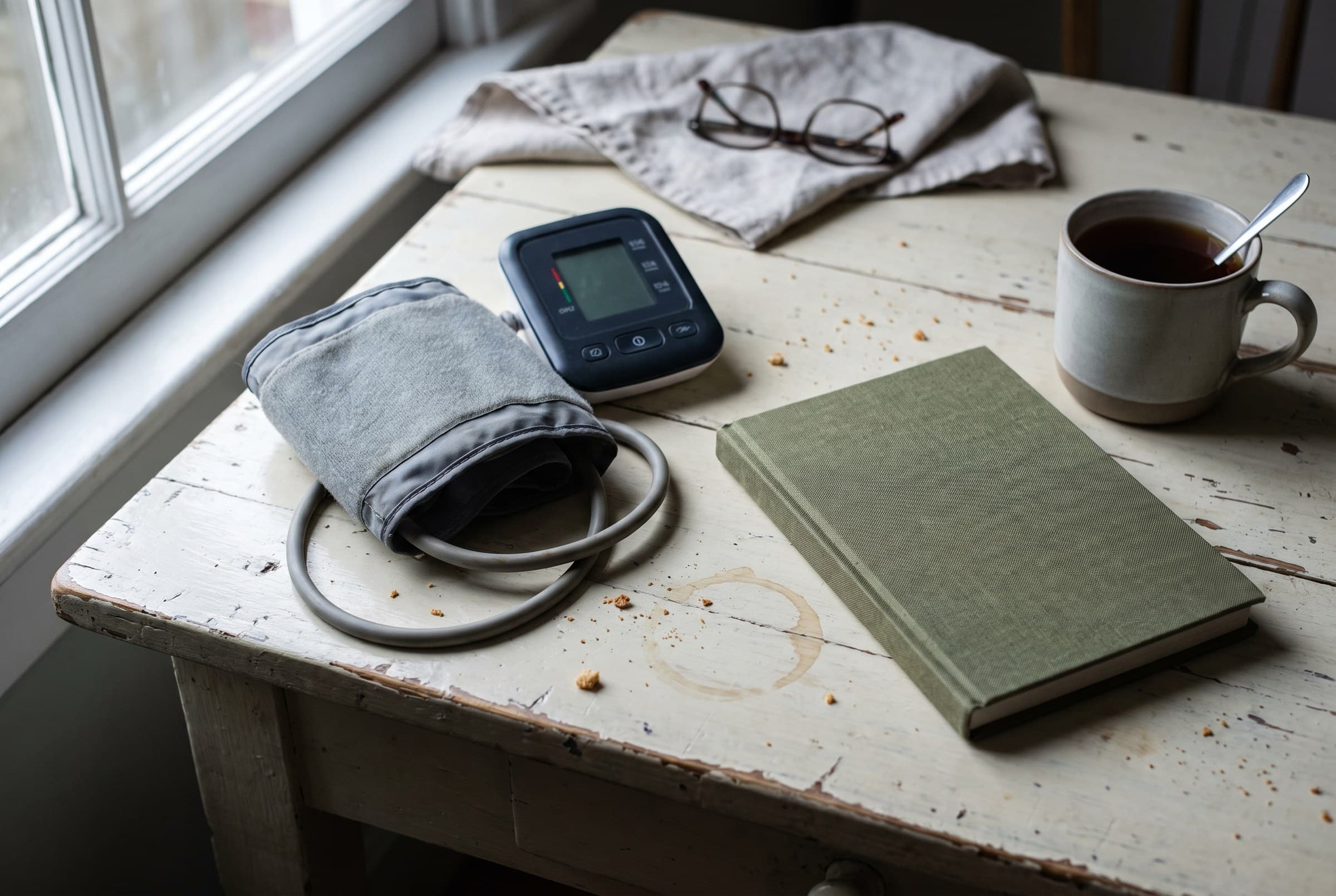
One office reading is noise; the honest number is a rested, seated home-cuff average — 2 readings morning and night across 3–7 days [3].
Because blood pressure is a moving target and the doctor's office moves it. The American Heart Association's measurement statement documents substantial differences between office readings and readings taken elsewhere — in both directions. Some people run high only at the clinic (the white-coat pattern); others run high only outside it, which the office visit never sees [3].
You also arrive wrong. Caffeine, exercise, or smoking within 30 minutes; a full bladder; talking; an unsupported arm — each one nudges the number. The AHA statement lists them all as things to rule out before a reading counts [3]. One rushed measurement after a stressful commute is a data point about the commute.
That's the home-cuff protocol, straight from the statement: an automated upper-arm cuff, the setup above, and the average across 3–7 days [3]. Day one is sometimes thrown out — first-day readings can run high [3]. The average of 12–28 calm readings is the honest number. Bring that to your doctor, not the single reading from a bad Tuesday.
04What does exercise do to resting blood pressure?
Across 270 randomized trials, every major training mode lowered resting blood pressure — and isometric holds led the ranking at −8.2/−4.0 mmHg [4].
More than almost any other free thing, and the evidence here is unusually deep. A 2023 network meta-analysis pooled 270 randomized controlled trials — 15,827 people — comparing every major training mode against non-exercising controls [4]. All of them lowered resting blood pressure: aerobic work by 4.5/2.5 mmHg, dynamic resistance training by 4.6/3.0, combined training by 6.0/2.5, HIIT by 4.1/2.5 [4].
The surprise winner was isometric training — holds, not reps — at 8.2/4.0 mmHg, ranked first of all modes [4]. The humble wall squat was the single most effective variation for the top number [4]. Two-ish minutes of quietly shaking against a wall, a few times a week, moved the number more than running programs did.
For scale: those are population averages from trials, not promises — but a handful of mmHg is the same order of magnitude that separates the category lines in the table above. The lifting and zone-2 work this site already programs sits squarely inside that evidence.

05What do you do with a high reading?
A high single reading earns more readings, not panic: a rested 7-day home-cuff average is the number worth bringing to a clinician [3].
First, nothing dramatic — you take more readings, properly. One elevated number after a sprint up the stairs with a toddler is noise; a rested 7-day home-cuff average is signal. That average, on paper, is the most useful thing you can carry into an appointment [3].
What the average means for you — and every question about medication — belongs with a clinician who knows your history, full stop. What an article can say: the drift starts young [1], and the lines are published [2]. The honest measurement costs one basic cuff and ten quiet minutes a day for a week [3]. Training measurably leans on the number [4]. Still able at 70 starts with knowing this one at 40.