
Endurance athletes keep roughly 70–80% of their cardio easy and give hard work most of the rest [1][2]. On a small weekly budget the pattern bends: one interval session buys the most fitness per minute [4][5]. Below: how to split 60, 90, or 150 minutes between zone 2 and VO2 max work.
01How do endurance athletes split easy and hard cardio?
Mostly easy, a hard slice, little in between: roughly 70–80% of training stayed easy in the plans that won trials [1][2].
This site already covers what zone 2 is and what VO2 max decides at 70. This page answers the question those two leave open. You have a fixed pile of cardio minutes each week. How many should be easy, and how many hard? Researchers call the answer an intensity distribution. Think of it like a paycheck. Most goes to rent — the easy minutes. A small slice goes to one expensive night out — the intervals. Almost nothing sits in the middle.
The trials lean that way. In a nine-week study of 41 trained athletes, the group at 68% easy and 26% hard raised VO2 peak by 11.7% [1]. The threshold group, with over half its time at a comfortably-hard middle pace, improved almost nothing [1]. A meta-analysis of randomized trials found the mostly-easy split beat the middle-heavy split on race-style tests — a moderate edge, from 64 athletes across three trials [2]. A 2025 pooled re-analysis of 13 studies and 348 athletes added a wrinkle: recreational athletes did as well or better when part of the hard slice became moderate work [3]. So there is no one magic ratio. The steady finding is that easy work earns most of the minutes, and the middle shouldn't eat your week.
02Do intervals build VO2 max faster than easy cardio?
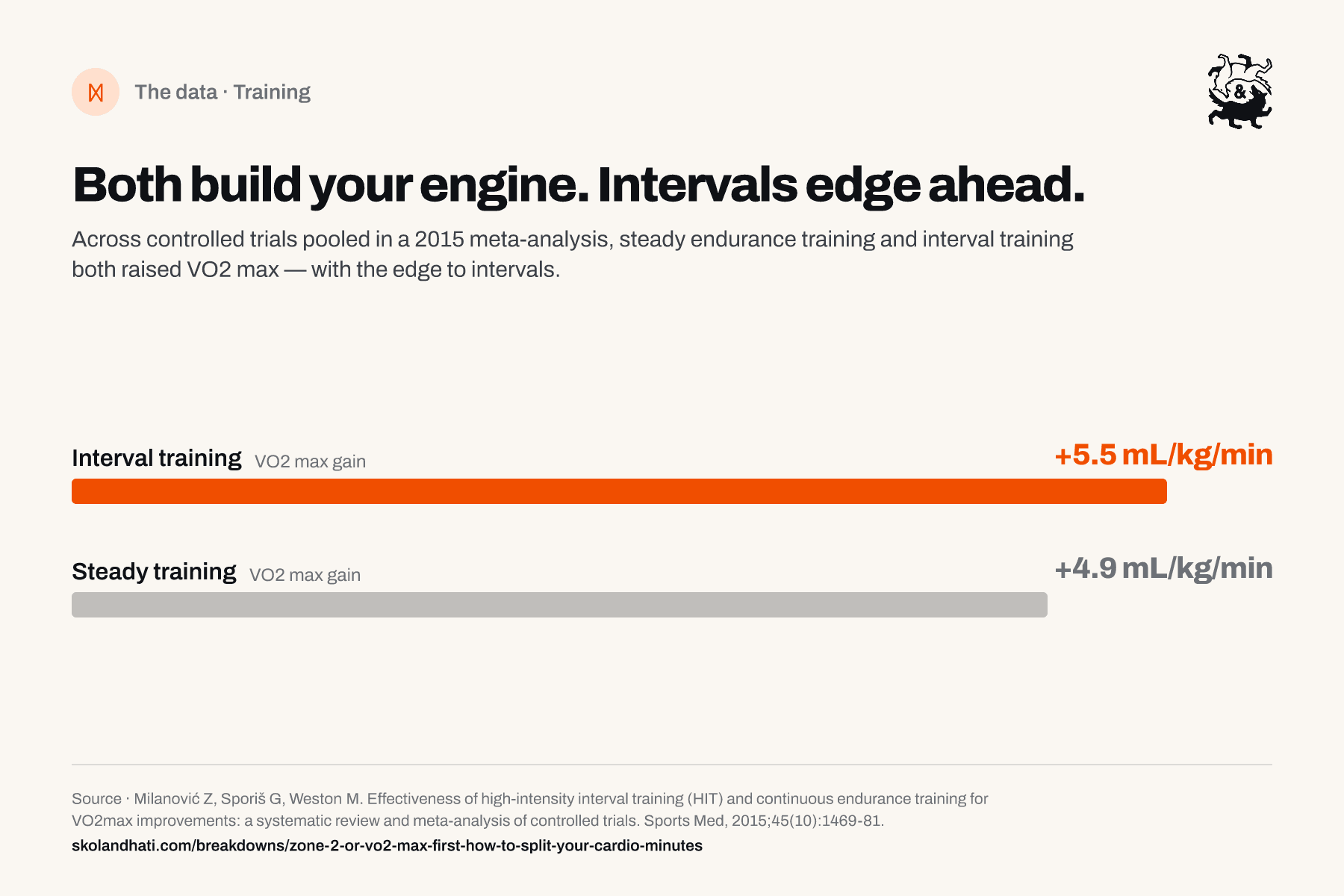
A little, yes. Across 28 trials, interval training beat steady cardio by about 1.2 mL/kg/min of VO2 max [4].
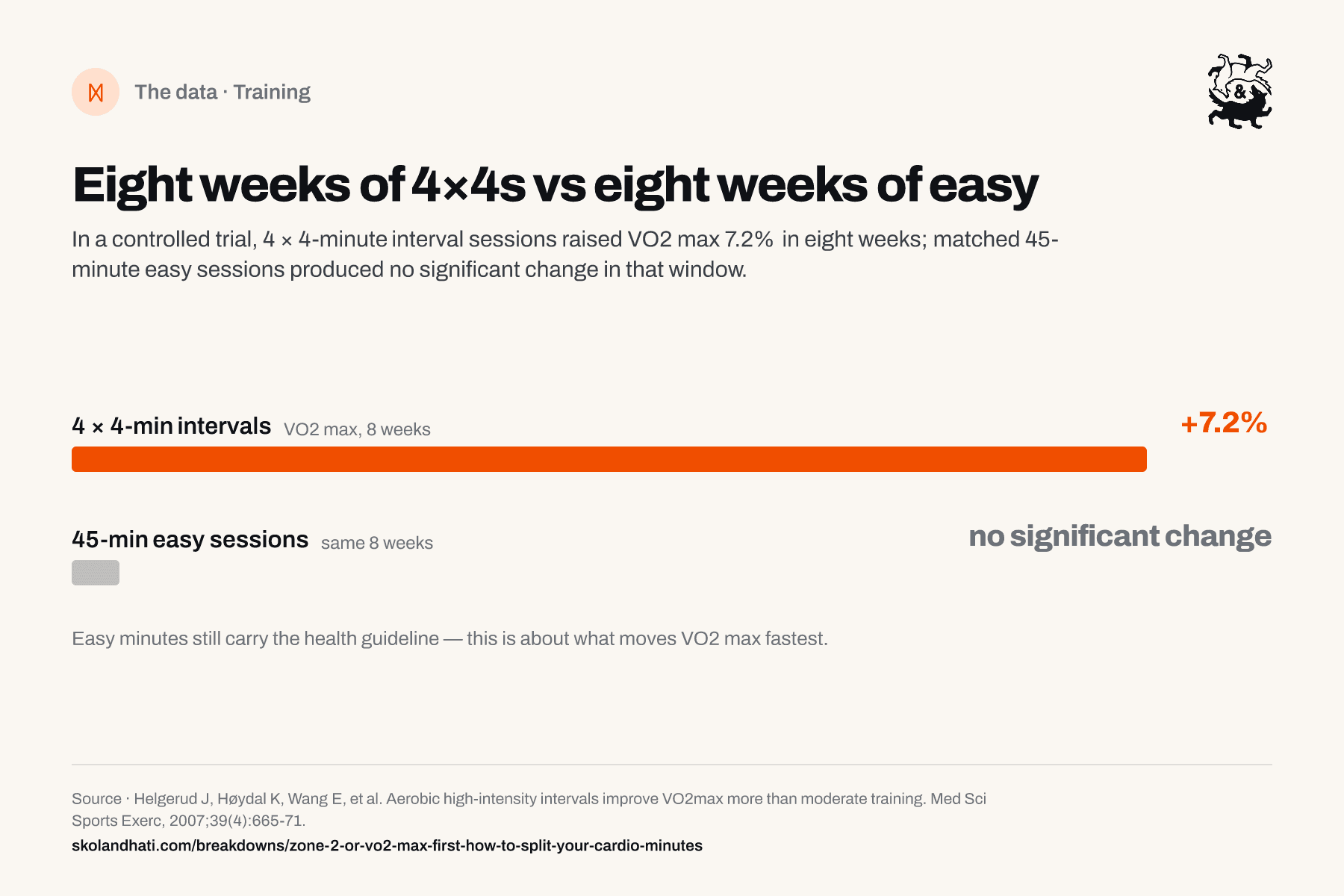
Head to head, both work. Across 28 controlled trials and 723 people, steady endurance training raised VO2 max by about 4.9 mL/kg/min against controls, and interval training raised it by about 5.5 [4]. The direct gap was roughly 1.2 mL/kg/min in favor of intervals [4]. The sharper result is older. In an eight-week trial, 4 × 4-minute intervals near 90–95% of max heart rate raised VO2 max by 7.2%, while 45 easy continuous minutes barely moved it [5]. Minute for minute of discomfort, intervals are the concentrated product.
So why not make every minute hard? Because hard minutes bill you twice. You pay once during the session and again in the days after — heavier legs, less appetite for the next workout. The interval trials ran on young, fit volunteers doing three supervised sessions a week [5]. For people with full lives, where a missed week is the base case, a plan is only as good as your willingness to repeat it. Easy minutes fill the rest of the budget because they add volume without crowding the rest days that hard work demands.
By signing up you agree to receive our emails, including occasional offers, and to the privacy policy.
03How should I split 60, 90, or 150 weekly minutes?
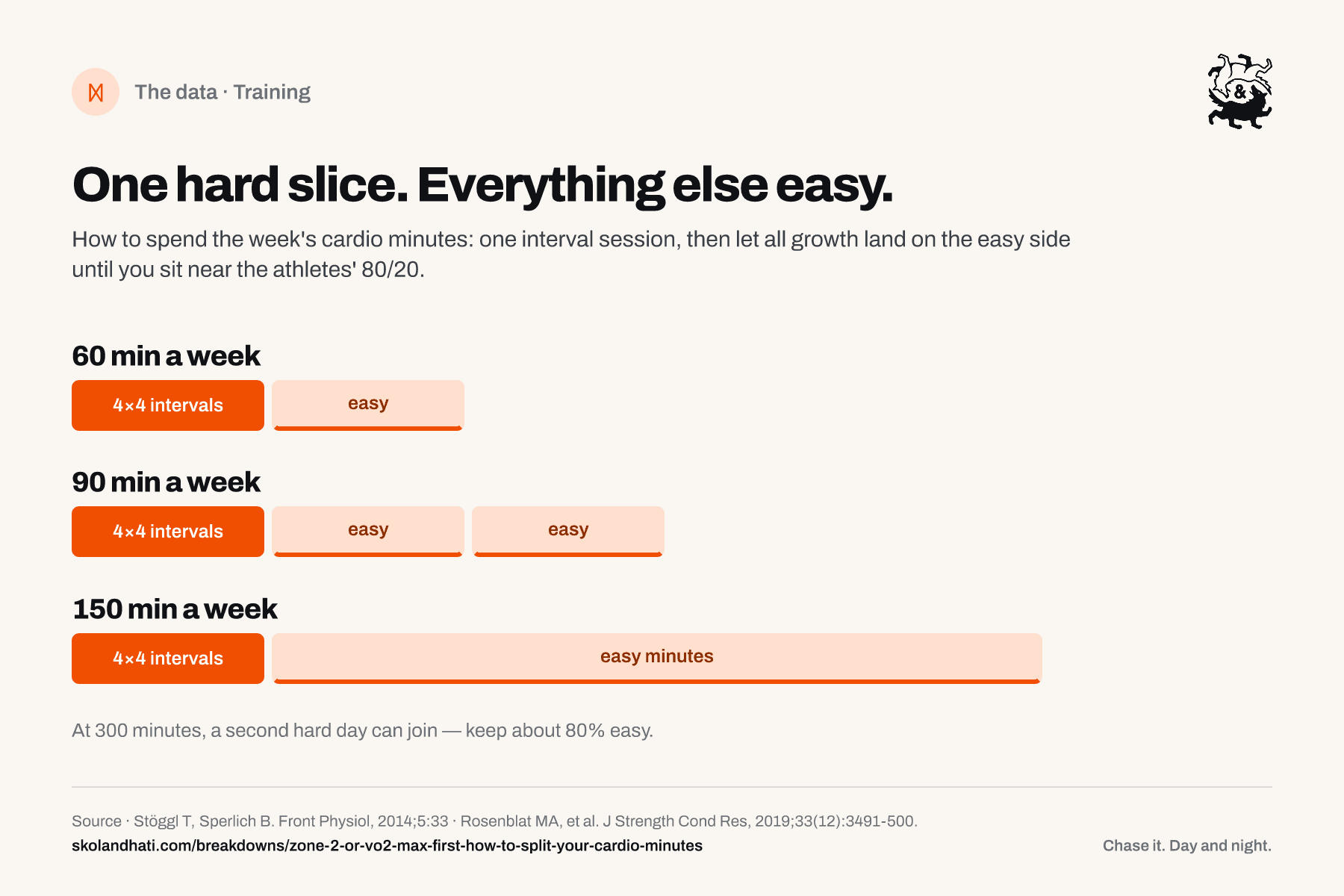
One hard session a week, everything else easy. As minutes grow, put the growth on the easy side until you sit near 80/20.
An honest label first: the split studies above were run on athletes training many hours a week. Nobody has randomized a 60-minute week. The table below is programming judgment, anchored to that athlete evidence, the interval trials, and the WHO ranges — not a tested prescription. The WHO asks adults for 150–300 minutes of moderate activity a week, or 75–150 vigorous minutes, or a mix [6]. Notice the exchange rate inside that sentence: one vigorous minute counts like two moderate ones.
At the bottom of the range, that math favors intensity. With 60 minutes, one interval session is the scarce purchase that moves VO2 max, and everything else stays easy. From 90 minutes up, the growth goes to the easy side, and by 150 you land near the athlete split without trying. A 4×4 session means four 4-minute hard efforts with 3-minute easy breaks — 25 minutes, plus a warm-up [5]. These are cardio minutes only; the strength half of the week lives in the training hub.
Should a beginner start with zone 2 or VO2 max intervals?
Can I just do HIIT and skip zone 2 completely?
Does the 80/20 rule apply to a 60-minute week?
How hard should a VO2 max interval feel?
Do easy minutes count toward the WHO 150-minute target?
General-audience information — not medical advice. Vigorous intervals are a real physical stress. If you're new to hard exercise, returning after a long layoff, or carrying a heart history, the green light for interval work is your doctor's call. This page is general education, not a training prescription. How we source and verify. No affiliate links in this breakdown. Published 2026-10-08.
Zone 2, translated: the minimum dose of easy cardio
Conversational pace, counted in minutes. The weekly target, the dose-response curve, and why your mouth beats your watch.
5 min · September 5, 2026TrainingVO2 max: the number that decides what you can do at 70
Your aerobic ceiling, in one number: what it is in plain language, where you stand by decade, how to estimate it without a lab — and how hard it tracks with the long game.
6 min · September 9, 2026