
Alcohol sedates the first half of the night and fragments the second. Around 2 drinks (0.5 g/kg) is where measurable REM loss begins; overnight recovery on a wearable drops 9, 24, or 39 percentage points as the dose climbs; and in one trial the disruption persisted with breath alcohol back at zero by lights-out.
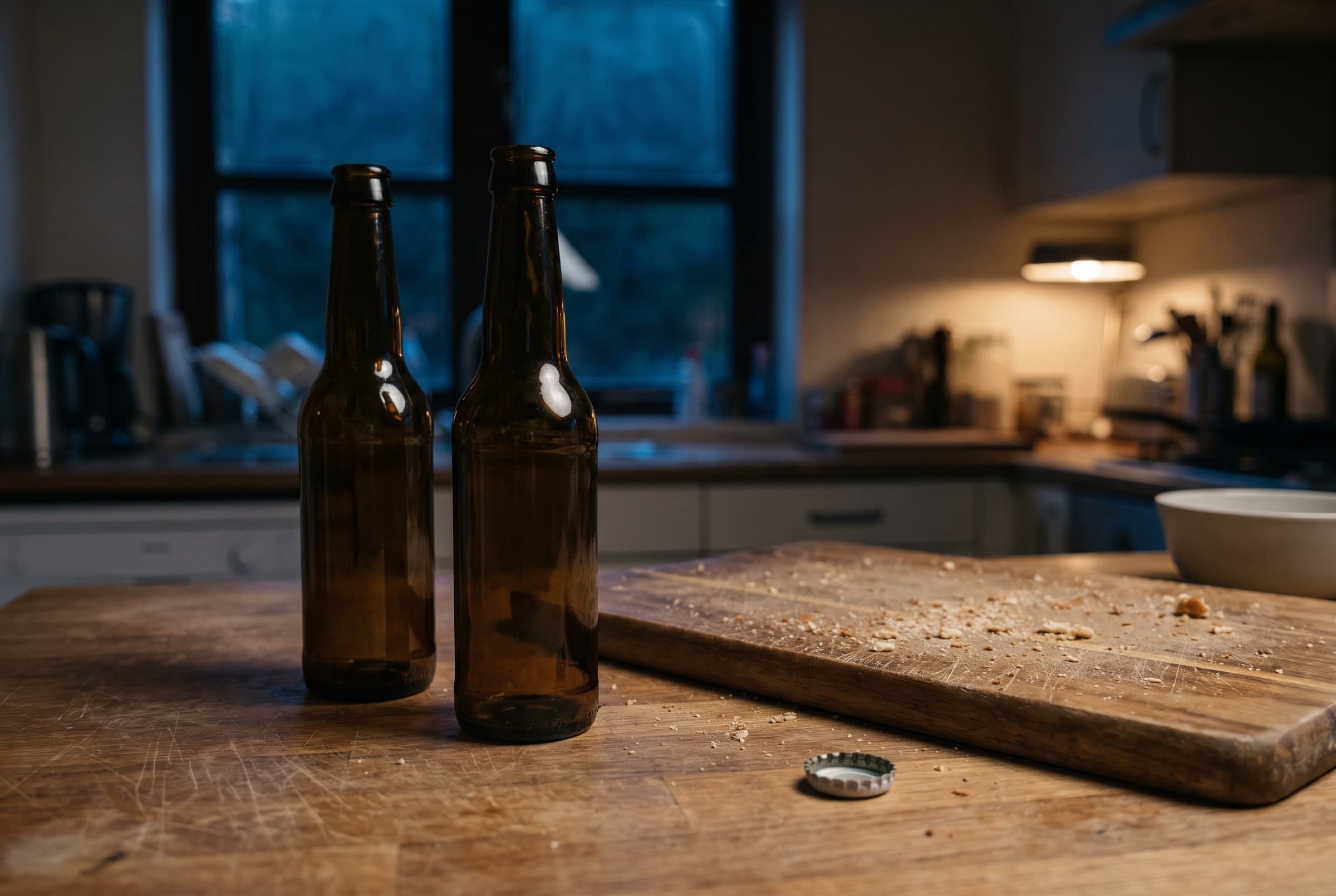
01Does alcohol help you fall asleep?
Alcohol gets you under faster but fragments the second half of the night at essentially any dose — sedation first, the bill later [1].
Partly — and that's the trap. The classic review of every controlled study on healthy sleepers found alcohol shortens the time to fall asleep and consolidates the first half of the night at essentially any dose [1]. A newer meta-analysis of 27 studies is stricter: the reliable fall-asleep-faster effect showed up only at high doses — roughly 0.85 g/kg, about 5 standard drinks [2].
Both agree on the back half. As the alcohol clears, the second half of the night runs the tab: more waking, lighter sleep, the 3 a.m. stare at the ceiling [1]. The nightcap isn't sleep aid pricing. It's a payday loan.
02How many drinks does it take to hurt REM sleep?
REM disruption starts around 2 standard drinks — 0.5 g/kg or less — and worsens progressively with dose [2].
About two. The 2025 meta-analysis found REM sleep disruption beginning at a low dose — 0.5 g/kg or less, which the authors put at roughly 2 standard drinks — and worsening progressively from there [2]. The first REM period arrives later at every dose, and total-night REM falls in most studies at moderate and high doses [1].
REM is the sleep stage most tied to memory and mood consolidation, and it's concentrated in the second half of the night — exactly the half alcohol fragments. That's why 7 hours after wine can feel like 5. Deep sleep runs the opposite schedule — it front-loads into the first half of the night.
By signing up you agree to receive our emails, including occasional offers, and to the privacy policy.
03Why does your watch score tank after drinking?
Across 4,098 adults, drinking evenings cut early-night recovery by 9 to 39 percentage points depending on dose — and fitness didn't blunt the effect [3].
Because your nervous system spends the night in traffic instead of parked. Researchers followed 4,098 Finnish adults wearing beat-to-beat heart-rate recorders through normal life. On drinking evenings, the first 3 hours of sleep ran higher heart rate, lower heart-rate variability, and less physiological recovery than the same person's dry evenings — dose-dependently, and starting at the lowest dose bracket [3].
Two findings worth sitting with: being fit didn't blunt the effect, and being young made it stronger, not weaker [3]. The gym does not pre-pay the bar tab.
04How long before bed should you stop drinking?
Even 3 drinks finished 6 hours before bed — breath alcohol zero at lights-out — still cut REM and doubled second-half waking [4].
Earlier helps — the liver clears alcohol at a steady rate, so a smaller dose finished sooner means less of it riding into the night. But the fade is slower than the buzz. In one trial, 10 middle-aged men drank 0.55 g/kg — call it 3 drinks — a full 6 hours before bedtime. Breath alcohol was zero in every one of them by lights-out. Sleep still suffered: total sleep and REM fell, and second-half wakefulness doubled [4].
Small study, older men, one dose — but it's the cleanest demonstration that zero on the breath is not zero in the brain. The practical version: the two dials that matter are how much and how often. When you drink matters, and it matters less than either.
05So are two Friday beers a problem?
Two early Friday beers are a small, contained cost; the real risk is drift — more drinks, more nights, closer to bedtime.
Here's the honest ledger. Two beers on Friday, done by 8 p.m., is a modest, contained cost: some REM loss, a lower recovery score, maybe a warmer first half of the night [2][3]. Saturday morning with the kids will be fine. What the evidence argues against isn't the ritual — it's the drift: two becoming four, Friday becoming most nights, the drink migrating toward bedtime because it “helps you sleep.” It doesn't. It sedates you, then invoices you at 3 a.m. [1]. The levers that do help are collected in the sleep playbook. Keep the beers if they're worth it to you. Just pay for them with open eyes, not with your Saturday.
Does a nightcap help you sleep?
Why is my resting heart rate up the morning after two beers?
If I stop drinking by 7 p.m., am I in the clear?
General-audience information — not medical advice. This page describes averages from published studies of healthy adults — general information, not medical advice. If alcohol is tangling with your sleep, mood, or mornings more than you'd like, that conversation belongs with a clinician who knows your history. How we source and verify. No affiliate links in this breakdown. Last updated 2026-09-05.
How much deep sleep do you actually need?
The number your watch shows, what the labs actually measure, and why you protect the window instead of chasing the stage.
5 min · September 5, 2026RecoveryHRV: what your watch is actually measuring
The gaps between your heartbeats, the math your watch runs on them, and why the number only means something compared with your own baseline.
5 min · September 5, 2026