
Caffeine's average half-life is about 5 hours: half of a 3 p.m. mug is still working at 8 p.m., a quarter at 1 a.m. In the classic trial, 400 mg disturbed sleep even 6 hours before bed; a meta-analysis gives one coffee an 8.8-hour cutoff. Count backward from bedtime, not forward from lunch.
01How long does caffeine actually stay in your system?
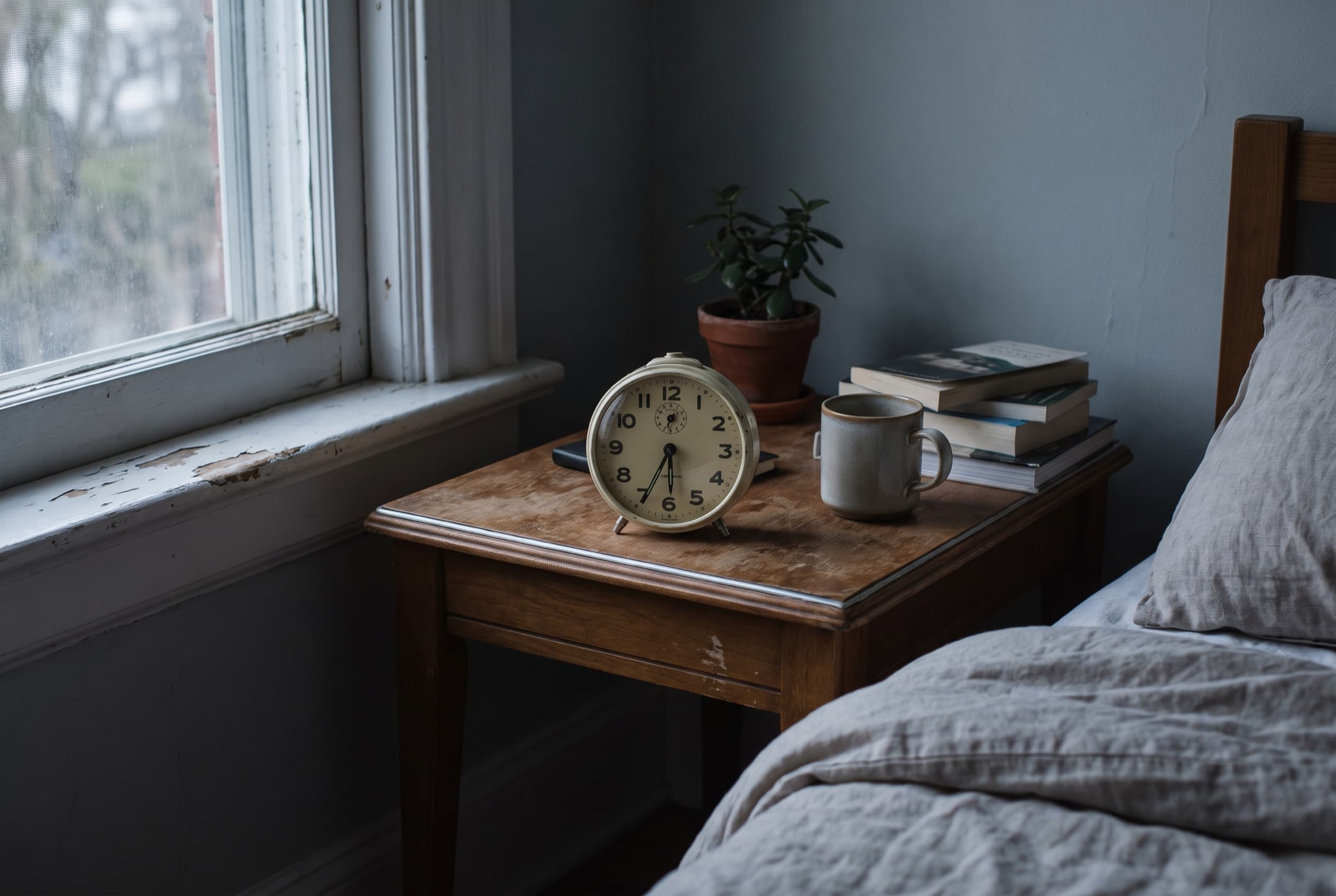
Caffeine's average half-life is about 5 hours — each cup fades by halves, so half is still working 5 hours later [1].
Caffeine doesn't leave when the feeling does. In the average adult its half-life is about 5 hours — every 5 hours, whatever remains gets cut in half [1]. That's a slow staircase, not a trapdoor, and it's why the afternoon cup — often poured against the 3 p.m. crash — matters at midnight in a way the morning cup doesn't.
The mug matters too. Regular brewed coffee runs 113–247 mg per 12 oz by the FDA's accounting; black tea about 71 mg; energy drinks anywhere from 41 to 246 mg [2]. The table below uses a 200 mg mug as the house example — adjust for yours.
02Why is the 3 p.m. coffee a midnight problem?
A 200 mg mug at 3 p.m. leaves roughly 50 mg on board at 1 a.m. — soda-can territory by the FDA's numbers [2].
Run one mug through the arithmetic and watch it outlast the afternoon.
At 1 a.m., roughly 50 mg is still on board — inside the FDA's caffeine range for a full 12 oz soda [2]. Nobody opens a soda at 1 a.m. and expects nothing. The 3 p.m. mug does the same job, just quietly.
By signing up you agree to receive our emails, including occasional offers, and to the privacy policy.
03How late is too late for caffeine?
400 mg disturbed sleep even 6 hours before bed, and pooled trials give one standard coffee an 8.8-hour cutoff [3][4].
The one head-to-head timing trial is blunt. 400 mg of caffeine — the FDA's entire daily reference in a single dose [2] — taken at bedtime, 3 hours before bed, or 6 hours before bed each measurably disturbed sleep versus placebo [3]. The authors' conclusion became the standard sleep-hygiene line: keep substantial caffeine a minimum of 6 hours away from bed [3]. Note what that is — a floor, not a target.
Pool the wider trial literature and the bill gets itemized: caffeine cost 45 minutes of total sleep, 7% of sleep efficiency, delayed sleep onset by 9 minutes, and added 12 minutes of mid-night wake [4]. Deep sleep specifically gave up 11.4 minutes [4]. The same review ran the clock backward and computed cutoffs: one standard coffee (107 mg) needs at least 8.8 hours of runway before bed; a standard pre-workout serving (217.5 mg) needs 13.2 [4].
A separate systematic review lands on the same pattern — longer time to fall asleep, less total sleep, lower efficiency, less deep sleep, worse-rated nights [5]. It adds the fine print: the damage tracks dose and timing, older adults may be more sensitive, and genes in the adenosine system help decide how hard caffeine hits your sleep [5].
04How do you set your own cutoff?
Subtract about 9 hours from the bedtime you actually keep — 10:30 p.m. lights-out puts the last full coffee near 1:30 p.m. [4].
Run the subtraction from the bedtime you actually keep, not the one you'd like. Lights out at 10:30 p.m. minus 9 hours puts the last full coffee at 1:30 p.m. — the 8.8-hour finding, rounded to something a human remembers [4]. An early gym alarm or a kid who ends your evening early moves the cutoff earlier still. The math doesn't negotiate; it just slides. Most levers in the sleep playbook work the same way — arithmetic first, willpower second.
Two honest adjustments. First, half-lives differ: smoking shortens caffeine's by up to 50%, pregnancy can stretch it toward 15 hours, and liver conditions or certain medications prolong it [1] — the cutoff that works for your coworker may fail you. Second, totals still count: the FDA cites 400 mg a day — about two to three 12 oz cups of coffee — as the amount not generally associated with negative effects for most adults [2].
Sleep sits in tier one of the recovery hierarchy — and this is the rare tier-one upgrade that costs nothing and takes no minutes. It's not an evening discipline. It's a 2 p.m. decision.
Does caffeine affect sleep even if I fall asleep fine?
When should I have my last coffee?
Is 400 mg of caffeine a day too much?
General-audience information — not medical advice. Caffeine limits shift with medications, pregnancy, and health conditions — the FDA's advice, and ours, is to check yours with your clinician. How we source and verify. No affiliate links in this breakdown. Last updated 2026-09-05.
How much deep sleep do you actually need?
The number your watch shows, what the labs actually measure, and why you protect the window instead of chasing the stage.
5 min · September 5, 2026NutritionThe 3 PM crash is your lunch talking
The afternoon dip is partly built into your biology — but the size and shape of lunch decides how hard it hits. Plain food fixes most of it; a 10-minute walk fixes the rest.
5 min · September 6, 2026